
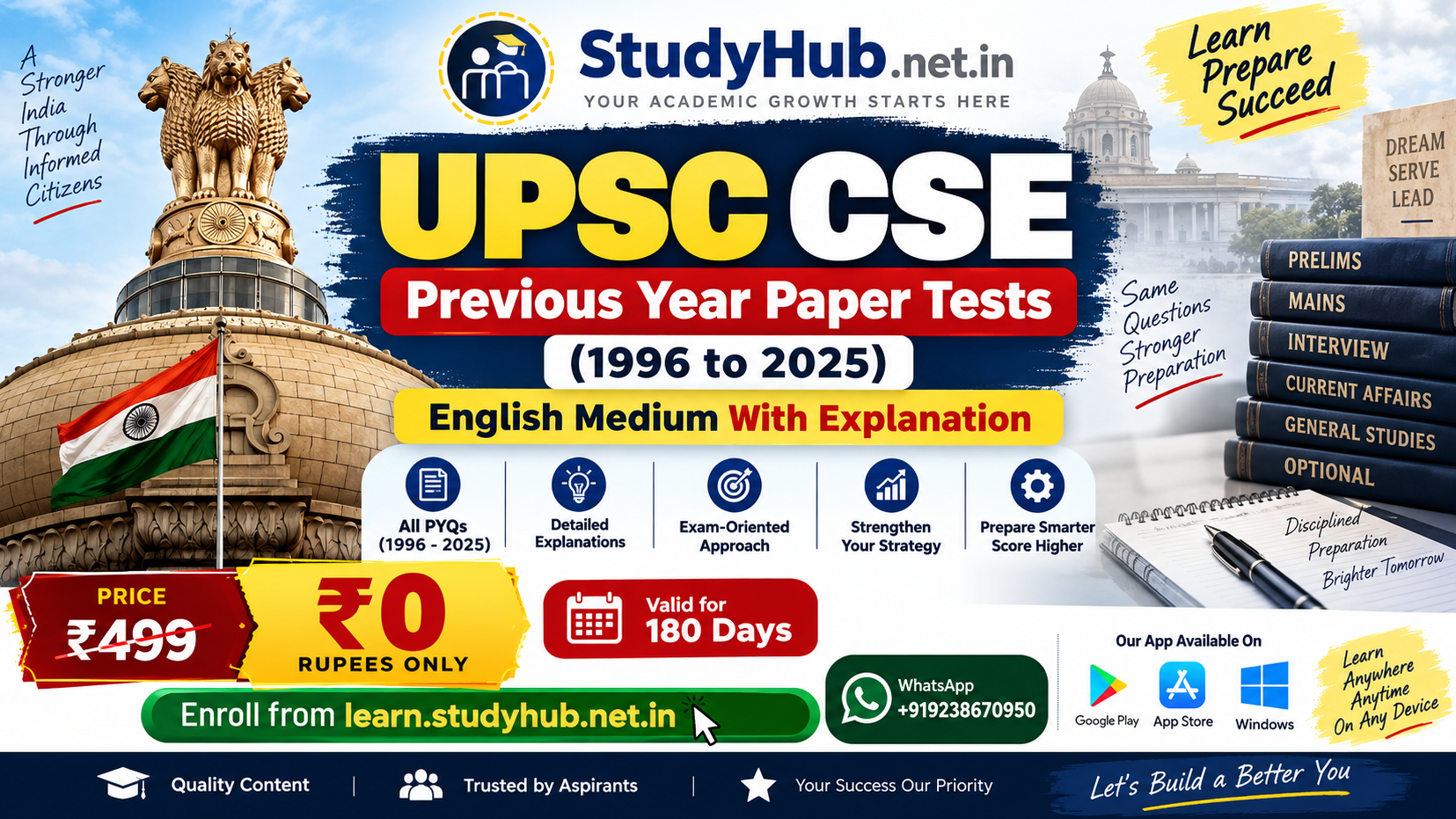
UPSC CSE Previous Year Paper Free Tests
Product information
- Number of chapters
- 2 Chapters
- Number of contents
- 40 Contents
- Course Validity
- Valid for 180 days
UPSC CSE Previous Year Paper Free Tests – UPSC Prelims PYQs, GS Paper 1 & GS Paper 2 Practice
UPSC CSE Previous Year Paper Free Tests – UPSC Prelims PYQs, GS Paper 1 & GS Paper 2 Practice
Preparing for the UPSC Civil Services Examination (UPSC CSE) becomes much easier when you start understanding the examination through actual previous year questions.
Reading books, making notes and following current affairs are important parts of UPSC preparation, but one question remains: What exactly does UPSC ask in the real examination?
That is where UPSC Previous Year Questions (PYQs) become extremely important.
We have created the UPSC CSE Previous Year Paper Free Tests course to help aspirants practise actual UPSC Civil Services previous year questions in an online test format. Instead of searching for different UPSC question papers across multiple websites, you can practise a large collection of UPSC Prelims Previous Year Papers from one dedicated StudyHUB course.
The course currently contains 2 chapters and 40 test contents, covering UPSC General Studies Paper-I and General Studies Paper-II. The course page also provides a Start Now – Free option and currently lists 180 days of course validity. UPSC CSE Previous Year Paper Free Tests – Course Highlights
- 2 Chapters
- 40 Total Contents
- UPSC General Studies Paper-I Previous Year Tests
- UPSC General Studies Paper-II Previous Year Tests
- UPSC Prelims PYQ Practice
- GS Paper-I tests covering years from 1996 to 2021 and 2023 to 2025
- GS Paper-II tests covering 2015 to 2025
- English Medium previous year paper tests
- 180 Days Course Validity
- Start Now – Free option available on the current course page
Why Are UPSC Previous Year Papers So Important?
If you are preparing for UPSC CSE Prelims, previous year questions should not be treated as just another practice resource.
They are one of the best ways to understand the actual demand of the examination.
UPSC can ask questions from familiar topics in unfamiliar ways. A student may study Polity, History, Geography, Economy or Environment in detail but still find the Prelims difficult because the question requires careful interpretation, elimination and application of knowledge.
When you solve previous year questions regularly, you start recognising how UPSC thinks.
You begin to understand:
- What type of factual information UPSC prefers to test
- How conceptual questions are framed
- How multiple statements are used in Prelims
- How options are designed to create confusion
- Which subjects and themes deserve greater attention
- How difficult the actual examination can be
- Where your own preparation is weak
That is why we recommend using UPSC Previous Year Papers throughout your preparation, not only during the final revision.
UPSC CSE Prelims Exam Pattern
The UPSC Civil Services Preliminary Examination consists of two compulsory objective-type papers. Both papers carry 200 marks, and each paper is of 2 hours duration.
| Paper | Subject | Marks | Duration | Nature |
|---|---|---|---|---|
| Paper-I | General Studies | 200 | 2 Hours | Used for merit / cutoff |
| Paper-II | CSAT – General Studies Paper-II | 200 | 2 Hours | Qualifying |
| Total | — | 400 | 4 Hours | — |
UPSC CSAT is a qualifying paper, with the minimum qualifying requirement prescribed at 33%. The marks of General Studies Paper-II are not counted for ranking, but you must qualify it to clear the Preliminary stage.
There is also negative marking for incorrect answers in the objective Preliminary papers, so accuracy and intelligent question selection are extremely important.
UPSC Prelims General Studies Paper-I
General Studies Paper-I is the main scoring paper in UPSC Prelims. Your performance in this paper is central to clearing the Preliminary cutoff.
The broad areas covered include:
- Current Events of National and International Importance
- History of India and Indian National Movement
- Indian and World Geography
- Indian Polity and Governance
- Economic and Social Development
- Environmental Ecology
- Biodiversity
- Climate Change
- General issues related to environment
- General Science
However, UPSC does not always ask these areas in a straightforward manner. Questions can combine current affairs with static subjects, such as Environment with Geography, Polity with current events, or Economy with government schemes.
This is one of the biggest reasons why solving UPSC GS Paper-I PYQs is so useful.
UPSC Prelims General Studies Paper-II – CSAT
General Studies Paper-II, commonly known as CSAT, is a qualifying paper, but it should not be ignored.
It tests areas such as:
- Comprehension
- Interpersonal skills including communication skills
- Logical reasoning
- Analytical ability
- Decision-making
- Problem-solving
- General mental ability
- Basic numeracy
- Data interpretation
For students who are comfortable with Quantitative Aptitude and Reasoning, CSAT may appear manageable. For others, especially candidates who have not studied Mathematics for a long time, regular practice is essential.
Our course includes UPSC General Studies Paper-II previous year tests covering the sessions listed on the StudyHUB course page from 2015 to 2025. ([learn.studyhub.net.in](https://learn.studyhub.net.in/products/upsc-cse-previous-year-paper-free-tests/))
UPSC CSE Previous Year Paper Coverage in This Course
We have structured the course around actual UPSC previous year papers so that you can practise the examination in a more realistic way.
UPSC General Studies Paper-I Previous Year Tests
The current course page lists English-medium General Studies Paper-I tests for:
1996, 1997, 1998, 1999, 2000, 2001, 2002, 2003, 2004, 2005, 2006, 2007, 2008, 2009, 2010, 2011, 2012, 2013, 2014, 2015, 2016, 2017, 2018, 2019, 2020, 2021, 2023, 2024 and 2025.
This gives you access to a long historical collection of UPSC Prelims General Studies Paper-I PYQs, allowing you to see how question framing and the examination trend have evolved over time.
UPSC General Studies Paper-II Previous Year Tests
The current course page lists English-medium GS Paper-II tests for:
2015, 2016, 2017, 2018, 2019, 2020, 2021, 2022, 2023, 2024 and 2025.
This provides a substantial collection of UPSC CSAT Previous Year Papers for practice.
UPSC Previous Year Papers from 1996 to 2025
One of the useful features of this course is the historical coverage of General Studies Paper-I.
Very old UPSC papers are still useful because they help you understand the foundation of the examination. Recent papers, on the other hand, are especially useful for understanding the modern style of UPSC question framing.
By solving papers from different years, you can compare:
- Older UPSC question patterns
- Modern UPSC question framing
- Changes in difficulty level
- Evolution of statement-based questions
- Changes in the way static and current topics are connected
- Frequently recurring concepts
Why You Should Solve UPSC PYQs Before Starting Full Mock Tests
Mock tests are useful, but they should not replace previous year questions.
Before attempting dozens of coaching-generated mock tests, every serious aspirant should become comfortable with the questions UPSC itself has asked.
Previous year questions help you establish a benchmark.
Once you understand the actual UPSC standard, you can better judge whether a mock test is genuinely useful or simply difficult for the sake of being difficult.
Our approach is therefore simple:
Understand UPSC PYQs → Analyse the Pattern → Strengthen Concepts → Attempt Mock Tests → Revise
How UPSC Previous Year Questions Help in Prelims Preparation
1. Understand the UPSC Question Pattern
UPSC questions often test more than memory. PYQs help you understand how the Commission uses statements, options and conceptual traps.
2. Learn the Art of Elimination
In many UPSC questions, you may not know the answer immediately. Elimination of incorrect options becomes extremely important.
By solving previous year papers, you can practise identifying statements that are clearly incorrect, partially correct or inconsistent with established concepts.
3. Identify High-Value Topics
PYQ analysis helps you identify topics that deserve repeated revision instead of spending equal time on everything in the syllabus.
4. Understand the Difference Between Easy and Difficult Questions
Not every question needs the same amount of time. Previous papers help you understand which questions can be answered quickly and which require deeper thought.
5. Improve Accuracy
Since negative marking matters in Prelims, your target should not simply be maximum attempts. Your target should be maximum correct attempts.
6. Build Confidence
After solving multiple years of actual UPSC questions, the examination becomes much less unfamiliar.
How to Use Our UPSC CSE Previous Year Paper Free Tests
Method 1 – Topic-Wise PYQ Practice
Complete a topic such as Polity, Economy, Environment or Modern History and then solve previous year questions related to that area.
Method 2 – Year-Wise Practice
Attempt the complete paper for a particular year under a time limit. This gives you a realistic picture of your performance.
Method 3 – Prelims Revision
During revision, use previous year papers as a rapid assessment tool. They can quickly show you which concepts you remember and which ones need another revision.
Method 4 – CSAT Practice
Use the GS Paper-II tests regularly if CSAT is one of your weaker areas. Do not wait until the last month to discover that your qualifying paper requires more preparation.
UPSC CSE Preparation Strategy Using PYQs
We recommend dividing your UPSC preparation into three broad stages.
Stage 1 – Build Your Foundation
Cover NCERTs, standard books, basic concepts and current affairs. Build a strong foundation in Polity, History, Geography, Economy, Environment and Science.
Stage 2 – Start PYQ Analysis
Once you have basic understanding, start solving previous year questions regularly. Do not wait for your syllabus to be completely finished.
Stage 3 – Test and Revise
Use PYQs and mock tests together. Let your mistakes determine what you revise next.
This approach is much more effective than taking test after test without analysing your weak areas.
UPSC Prelims PYQ Analysis – What Should You Look For?
When reviewing a previous year paper, do not look only at the correct answer.
Ask yourself:
- Why is the correct option correct?
- Why are the other options incorrect?
- Was the question based on a static concept or current affair?
- Could I have solved it through elimination?
- Did I understand the question correctly?
- Was I too slow?
- Did I make a factual mistake?
This is how a previous year paper becomes a learning resource rather than just a test.
UPSC CSE Previous Year Paper Free Tests for Beginners
If you are a beginner, you do not need to feel that PYQs are only for advanced aspirants.
In fact, the earlier you start solving actual UPSC questions, the better you can understand what the examination expects.
Instead of spending months preparing from books without looking at UPSC questions, use PYQs alongside your study from the beginning.
At first, the questions may seem difficult. That is normal. As your concepts improve, the same questions become much easier to understand.
UPSC CSE Previous Year Paper Practice for Serious Aspirants
If you are already preparing for UPSC, this course can be used as a dedicated PYQ practice resource.
You can use it to:
- Revise old topics
- Test your preparation
- Analyse UPSC trends
- Practise elimination techniques
- Improve time management
- Prepare for the Prelims examination
- Strengthen weak areas before taking full mock tests
Who Can Use This UPSC Previous Year Paper Test Series?
This course is suitable for a wide range of UPSC aspirants:
- UPSC CSE beginners
- UPSC Prelims aspirants
- UPSC CSE 2026 aspirants
- UPSC CSE 2027 aspirants
- UPSC Prelims repeaters
- UPSC GS Paper-I preparation students
- UPSC CSAT / GS Paper-II aspirants
- IAS aspirants
- IPS aspirants
- IFS aspirants through the Civil Services Examination
- Students preparing for Civil Services after graduation
- Working professionals preparing for UPSC
- Students looking for UPSC PYQ online tests
- Aspirants searching for free UPSC previous year paper tests
UPSC IAS Previous Year Questions – Why They Matter
Many aspirants search for IAS Previous Year Questions, UPSC Previous Year Papers, UPSC Prelims PYQs and UPSC CSE question papers as separate resources.
In reality, these searches largely refer to the same essential preparation resource: questions asked by UPSC in the Civil Services Examination.
Using actual UPSC questions gives you a direct connection with the examination instead of relying only on predictions.
UPSC GS Paper 1 Previous Year Papers
General Studies Paper-I is the main paper for Prelims merit. Our course includes a substantial collection of UPSC GS Paper 1 Previous Year Papers in online test format.
These papers cover subjects such as:
- History
- Geography
- Polity
- Economy
- Environment and Ecology
- Science and Technology
- Current Affairs
Solving multiple years of GS Paper-I helps you understand how static knowledge and current issues can be combined in UPSC questions.
UPSC CSAT Previous Year Papers
CSAT is qualifying, but qualifying does not mean optional.
You must clear the qualifying requirement to move ahead in the Civil Services Preliminary Examination process.
Our course includes UPSC General Studies Paper-II Previous Year Tests from 2015 to 2025, giving you a useful collection for CSAT practice. ([learn.studyhub.net.in](https://learn.studyhub.net.in/products/upsc-cse-previous-year-paper-free-tests/))
Use these papers to practise:
- Reading comprehension
- Logical reasoning
- Quantitative aptitude
- Basic numeracy
- Data interpretation
- Analytical ability
Why Our Free UPSC PYQ Tests Are Useful
The biggest benefit is convenience.
Instead of finding separate PDF files, downloading papers, printing them and manually tracking your practice, you can attempt previous year papers online in a structured test environment.
You can use the course as a regular part of your preparation and return to the papers whenever you need revision.
Course Details
- Course Name: UPSC CSE Previous Year Paper Free Tests
- Exam: UPSC Civil Services Examination (CSE)
- Chapters: 2
- Total Contents: 40
- General Studies Paper-I: Previous year tests listed from 1996–2021 and 2023–2025
- General Studies Paper-II: Previous year tests listed from 2015–2025
- Medium: English Medium
- Course Validity: 180 Days
- Access: Start Now – Free option currently available
Frequently Asked Questions – UPSC Previous Year Paper Free Tests
What is the UPSC CSE Previous Year Paper Free Tests course?
It is an online collection of UPSC Civil Services previous year question paper tests designed for Prelims preparation. The current course contains 40 contents across General Studies Paper-I and General Studies Paper-II. ([learn.studyhub.net.in](https://learn.studyhub.net.in/products/upsc-cse-previous-year-paper-free-tests/))
Are UPSC Previous Year Papers available for free?
The current StudyHUB course page provides a Start Now – Free option for this course. The page also shows individual test entries and a “Buy to Unlock” indication for the listed contents, so access conditions can vary by test. ([learn.studyhub.net.in](https://learn.studyhub.net.in/products/upsc-cse-previous-year-paper-free-tests/))
Which UPSC GS Paper-I years are included?
The current course page lists GS Paper-I tests from 1996 through 2021, followed by 2023, 2024 and 2025. ([learn.studyhub.net.in](https://learn.studyhub.net.in/products/upsc-cse-previous-year-paper-free-tests/))
Which UPSC CSAT years are included?
The course page lists General Studies Paper-II tests from 2015 through 2025. ([learn.studyhub.net.in](https://learn.studyhub.net.in/products/upsc-cse-previous-year-paper-free-tests/))
Is this course useful for UPSC CSE Prelims?
Yes. The course is specifically focused on previous year questions for the two UPSC Preliminary Examination papers and can be used for PYQ practice, revision and examination analysis.
Can beginners use these UPSC PYQ tests?
Absolutely. Beginners can start using PYQs early to understand the actual examination standard and gradually improve their preparation.
Is this useful for UPSC repeaters?
Yes. Repeaters can use previous year papers to identify recurring mistakes, compare their understanding with actual UPSC questions and build a more focused strategy for the next attempt.
Start Your UPSC Preparation with Real UPSC Questions
UPSC preparation becomes more meaningful when you stop preparing only from what you expect the examination to ask and start studying how UPSC has actually asked questions in previous years.
That is why we have created this UPSC CSE Previous Year Paper Free Tests course.
Practise General Studies Paper-I. Practise CSAT. Analyse the questions. Understand the options. Learn the UPSC pattern. Identify weak areas. Then revise and practise again.
Do not just read about UPSC. Solve UPSC questions.
Start UPSC CSE Previous Year Paper Tests for Free
40 Previous Year Paper Test Contents + GS Paper-I + GS Paper-II + English Medium + 180 Days Validity
Start Now – Free
Build your UPSC Prelims preparation around real previous year questions and understand the examination before you face it.
Start your UPSC CSE PYQ practice with StudyHUB today.