
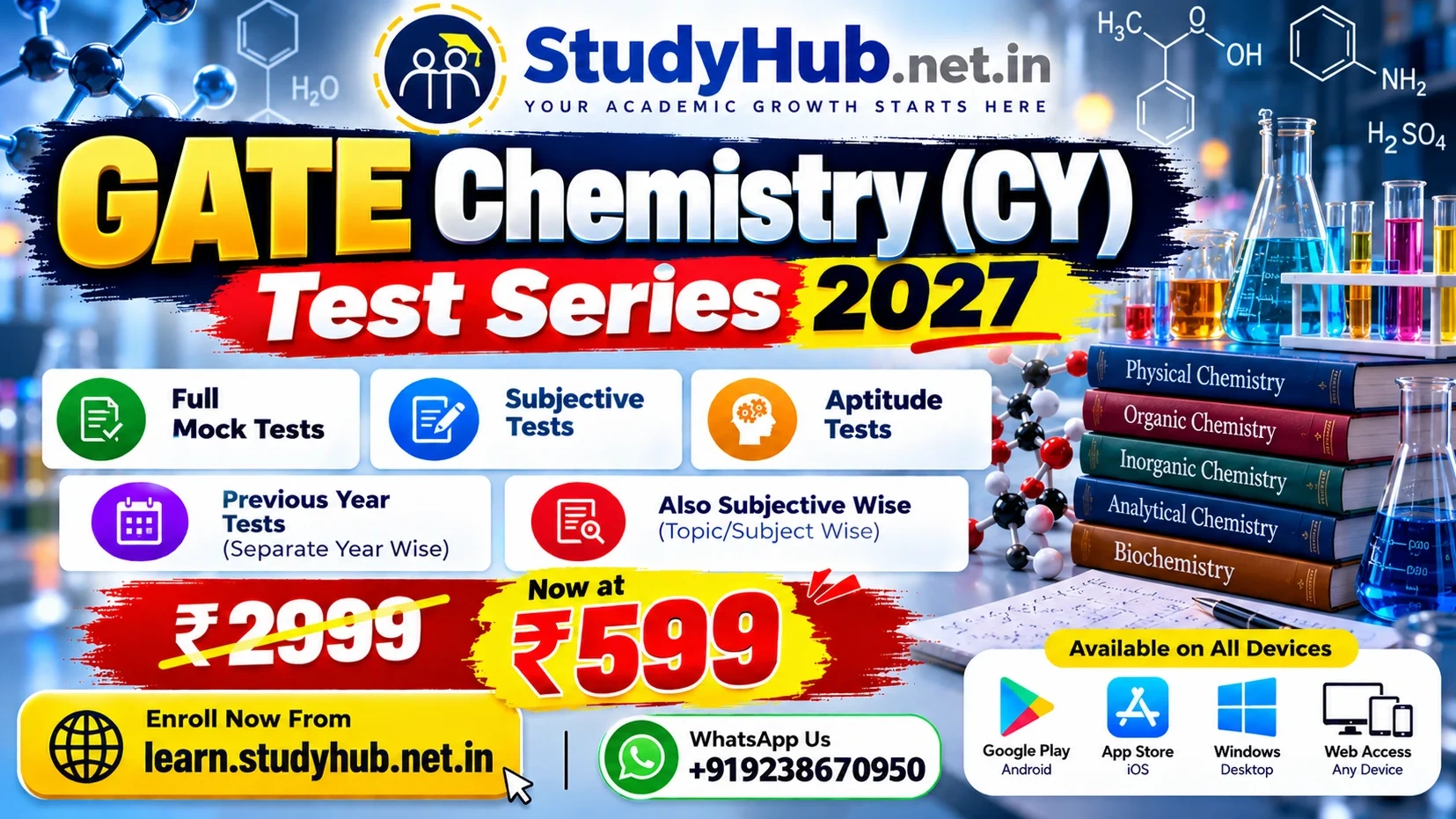
GATE Chemistry (CY) Test Series
Product information
- Number of chapters
- 5 Chapters
- Number of contents
- 117 Contents
- Course Validity
- Valid for 180 days
GATE Chemistry (CY) Test Series 2027 – Online Mock Tests, Practice Tests and Chemistry Exam Preparation Course Coupon Code: GATECY100 Discount: ₹100 OFF
GATE Chemistry (CY) Test Series 2027 – Online Mock Tests, Practice Tests and Chemistry Exam Preparation
Preparing for GATE Chemistry (CY) 2027? A good GATE preparation strategy requires more than reading textbooks and memorising reactions, formulas and concepts. You also need regular question practice, revision, numerical problem-solving and the ability to apply your knowledge within a limited time.
At StudyHUB, we have created the GATE Chemistry Test Series to support students preparing for the Graduate Aptitude Test in Engineering (GATE) Chemistry paper. Our online test series brings together practice resources for Physical Chemistry, Inorganic Chemistry and Organic Chemistry, helping you practise different types of questions and assess your preparation as you progress through the syllabus.
Whether you are beginning your GATE CY preparation, revising important Chemistry concepts or preparing for a final round of mock tests, you can use our course alongside your regular studies to strengthen your understanding, identify weak topics and improve your exam strategy.
The course includes different categories of Chemistry practice, such as unit-wise tests, reference-book-based practice, minor tests, part tests, major tests and full-length mock tests. We continue to improve and expand the course, so please refer to the Course Curriculum section on this page for the latest available topics and tests.
GATE Chemistry (CY) Test Series 2027 – Special Discount Offer
Get access to the StudyHUB GATE Chemistry (CY) Test Series at a special discounted price. Practise Physical Chemistry, Inorganic Chemistry and Organic Chemistry with topic-wise tests, part tests, major tests and full-length mock tests as available in the course curriculum.
Original Price: ₹2,999
Offer Price: ₹599
Extra Discount with Coupon: ₹100 OFF
Final Price After Coupon: ₹499
Use Coupon Code GATECY100 to Save ₹100
Apply the coupon code GATECY100 at checkout to get an additional ₹100 discount on the ₹599 offer price. Your final payable course price will be just ₹499 after successful coupon application.
- Visit the GATE Chemistry (CY) Test Series course page.
- Click the purchase or enrolment option.
- Enter coupon code GATECY100 in the coupon field and apply it.
- Verify that the final payable amount is ₹499 before completing the purchase.
Course Validity: 180 Days
Your course access remains valid for 180 days from the date of purchase. Use this period to practise the available tests, revise difficult topics and assess your preparation for GATE Chemistry.
Enrol now: GATE Chemistry (CY) Test Series – StudyHUB
Prepare with a structured test-practice routine and get the course for just ₹499 using coupon code GATECY100.
What Is Included in the StudyHUB GATE CY Test Series?
We have organised the course into different categories to help you practise at different stages of your GATE Chemistry preparation.
1. Unit-Wise Chemistry Tests
Unit-wise tests help you focus on particular Chemistry topics instead of attempting questions from the entire syllabus every time. After completing a chapter or topic from your study material, you can attempt the relevant test and check how well you understand the concepts.
The available practice covers topics such as stereochemistry, organic spectroscopy, chemical bonding, group theory, acid-base and solvent theory, periodic properties, chemical kinetics, photochemistry, atomic structure, quantum chemistry, organic reaction mechanisms, organometallic chemistry, thermodynamics, electrochemistry, equilibrium, coordination chemistry and other important Chemistry areas.
2. Reference-Book-Based Practice
Reference-book-based practice can help you reinforce concepts that you have studied in standard Chemistry textbooks and notes. Use these tests to connect theoretical understanding with problem-solving and revisit the relevant material whenever you find a question difficult.
3. Minor Tests for Subject-Wise Practice
Minor tests provide focused practice for areas of Physical Chemistry, Inorganic Chemistry and Organic Chemistry. They can be particularly useful when you want to evaluate your understanding of a subject before moving to a broader test.
4. Part Tests and Major Tests
Part tests and major tests help you practise a broader range of topics together. They are useful when you have covered multiple units and want to check whether you can recall and apply concepts across different areas of Chemistry.
5. Full-Length GATE Chemistry Mock Tests
Full-length mock tests help you practise the complete GATE Chemistry examination pattern. They can help you build time-management skills, improve question selection and become more comfortable with the pressure of a time-bound examination.
Important: The course content is updated and may expand. Please check the live Course Curriculum for the latest test names, available topics and complete list of included practice resources rather than relying on a fixed chapter or test count in this description.
GATE Chemistry (CY) 2027 Exam Pattern
Understanding the examination pattern is an important part of preparation. The official GATE 2027 Chemistry paper follows the general GATE question format, with General Aptitude and Chemistry subject questions.
| Exam Particular | GATE CY 2027 Details |
|---|---|
| Examination | Graduate Aptitude Test in Engineering (GATE) |
| Paper Name | Chemistry |
| Paper Code | CY |
| Examination Mode | Computer-Based Test (CBT) |
| Duration | 3 hours |
| Total Questions | 65 |
| Total Marks | 100 |
| General Aptitude | 15 marks |
| Chemistry Subject Questions | 85 marks |
| Question Types | Multiple Choice Questions (MCQs), Multiple Select Questions (MSQs) and Numerical Answer Type (NAT) questions |
| Question Marks | Questions carry 1 or 2 marks |
| Examination Language | English |
GATE CY Negative Marking
- Incorrect 1-mark MCQ: One-third of a mark is deducted.
- Incorrect 2-mark MCQ: Two-thirds of a mark is deducted.
- MSQ and NAT questions: There is no negative marking for incorrect answers.
- MSQs: There is no partial marking.
Because MCQs carry negative marking, avoid random guessing. During mock-test analysis, pay attention to the difference between conceptual mistakes, calculation errors and questions attempted without sufficient confidence.
For the latest details, refer to the official GATE 2027 question paper pattern.
GATE Chemistry (CY) 2027 Syllabus: Important Topics
The official GATE Chemistry syllabus is organised into three main subject areas: Physical Chemistry, Inorganic Chemistry and Organic Chemistry. General Aptitude is also part of the examination. Use the official syllabus to plan your preparation, and use the StudyHUB Course Curriculum to locate the tests relevant to the topics you have studied.
1. Physical Chemistry
Physical Chemistry requires a clear understanding of mathematical relationships, chemical principles and the interpretation of physical models. Important syllabus areas include:
- Quantum Chemistry and Atomic Structure: Postulates of quantum mechanics, operators, wave functions, Schrödinger equations, particle-in-a-box models, harmonic oscillators, angular momentum, hydrogen-like atoms, multi-electron atoms and approximation methods.
- Molecular Structure and Chemical Bonding: Born-Oppenheimer approximation, valence bond theory, molecular orbital theory, hybridisation and Hückel theory.
- Group Theory: Symmetry elements and operations, groups, representations, molecular point groups and applications of symmetry to spectroscopy and molecular orbitals.
- Spectroscopy: Atomic spectroscopy, rotational and vibrational spectroscopy, electronic and Raman spectroscopy, selection rules, line broadening and basic Nuclear Magnetic Resonance (NMR) principles.
- Thermodynamics and Chemical Equilibrium: Laws of thermodynamics, thermodynamic functions, Gibbs-Helmholtz and Maxwell relations, chemical potential, fugacity, activity, spontaneity and equilibrium constants.
- Solutions and Electrochemistry: Ideal and non-ideal solutions, Raoult's law, Henry's law, electrode potentials, electrochemical cells, the Nernst equation, ionic conductivity and electrochemical titrations.
- Phase Equilibria: Phase rule, Clausius-Clapeyron equation, one-component and two-component phase diagrams, fractional distillation, azeotropes and eutectics.
- Statistical Thermodynamics: Statistical ensembles, Boltzmann distribution, partition functions and thermodynamic properties of simple systems.
- Chemical Kinetics and Reaction Dynamics: Reaction mechanisms, steady-state approximation, transition-state theory, catalysis, fast reactions, polymerisation kinetics, photophysical processes and kinetic isotope effects.
- Surfaces and Interfaces: Adsorption, adsorption isotherms, surface catalysis, surface tension, viscosity, colloids, micelles and macromolecules.
2. Inorganic Chemistry
Inorganic Chemistry combines periodic trends, chemical bonding, coordination chemistry, the chemistry of elements and instrumental analytical techniques. Important areas include:
- Main Group Elements: Molecular shapes, hydrides, halides, oxides, oxoacids, nitrides, sulfides, boranes, carboranes, silicates, silicones, noble gases, interhalogen compounds and acid-base concepts.
- Transition Metals and Coordination Chemistry: Structure and isomerism, Valence Bond Theory (VBT), Crystal Field Theory (CFT), Molecular Orbital Theory (MOT), crystal field splitting, CFSE, Jahn-Teller distortion, electronic spectra and magnetic properties.
- Coordination Complexes: Spectroscopic term symbols, Orgel diagrams, Tanabe-Sugano diagrams, reaction mechanisms, stability, substitution reactions and redox reactions.
- Lanthanides and Actinides: Recovery, periodic properties, spectral properties and magnetic properties.
- Organometallic Chemistry: The 18-electron rule, metal-carbonyl and metal-alkyl complexes, metallocenes, fluxionality, organometallic reactions and homogeneous and heterogeneous catalysis.
- Bioinorganic Chemistry: Ion transport, oxygen binding and transport, electron transfer, nitrogen fixation and the role of metals in biological systems.
- Solid State Chemistry: Crystal systems and lattices, Miller planes, crystal packing, defects, Bragg's law, ionic crystals, spinels, band theory, metals, semiconductors and zeolites.
- Instrumental Methods of Analysis: UV-visible and fluorescence spectroscopy, FT-IR, NMR, ESR, mass spectrometry, atomic absorption spectroscopy, Mössbauer spectroscopy, X-ray crystallography, cyclic voltammetry and thermal analysis methods.
3. Organic Chemistry
Organic Chemistry requires you to understand reaction mechanisms, stereochemistry, the behaviour of functional groups, named reactions, reagents and multistep synthesis. Important syllabus areas include:
- General Organic Chemistry: Structure-property relationships, acidity, basicity and aromatic stability.
- Stereochemistry: Chirality, symmetry, absolute configuration, optical purity, conformational analysis, geometrical isomerism, stereoselective reactions and enantiomeric excess.
- Reaction Mechanisms: Kinetic and thermodynamic control, Hammond's postulate, the Curtin-Hammett principle, substitution and elimination reactions, solvent effects and reactive intermediates.
- Types of Organic Reactions: Nucleophilic and electrophilic substitution, addition, elimination, molecular rearrangements, carbocations, carbanions, carbenes, nitrenes, arynes and free radicals.
- Organic Synthesis: Synthesis and reactions of important functional groups, reagents, carbon-carbon bond formation, coupling reactions, retrosynthetic analysis, protecting groups, selectivity and asymmetric synthesis.
- Oxidation and Reduction: Common oxidation and reduction reagents, catalytic hydrogenation, hydride-transfer reagents, hydroboration-oxidation, ozonolysis and asymmetric oxidation reactions.
- Pericyclic Reactions and Photochemistry: Electrocyclic reactions, cycloaddition, sigmatropic rearrangements, Diels-Alder reactions, Claisen and Cope rearrangements, Woodward-Hoffmann rules and photochemical reactions.
- Heterocyclic Chemistry: Structure, nomenclature, preparation, properties and reactions of important heterocyclic compounds such as furan, pyrrole, thiophene, pyridine, indole, quinoline and isoquinoline.
- Biomolecules: Carbohydrates, amino acids, peptides, proteins, nucleic acids, lipids, steroids, terpenoids, carotenoids and alkaloids.
- Experimental Techniques: Polarimetry, chromatography, UV-visible spectroscopy, IR, NMR and mass spectrometry for organic structure determination.
The topic summary above is for preparation guidance, not a replacement for the official syllabus. The GATE 2027 syllabus has been published with updates, so use the latest official document while planning your studies. View the official GATE 2027 Chemistry (CY) syllabus PDF.
How to Use the GATE Chemistry Test Series Effectively
We recommend combining the test series with your regular concept study instead of attempting tests without a revision plan. A simple and consistent approach can make your practice more useful.
Step 1: Study the Topic First
Read the relevant theory, revise formulas, understand important reaction mechanisms and solve examples before attempting a topic-wise test.
Step 2: Attempt the Relevant Unit-Wise Test
Once you have studied a topic, attempt the relevant test to check whether you can apply your knowledge to exam-style questions. Do not be discouraged by an initial low score; use it to identify what needs more attention.
Step 3: Analyse Every Mistake
After completing a test, review incorrect answers and questions you found difficult. Determine whether you need to revise a concept, practise a calculation, memorise an important reaction or improve your question-reading skills.
Step 4: Practise Multiple Topics Together
When you become comfortable with individual topics, use the available minor, part and major tests to practise switching between different areas of Chemistry.
Step 5: Attempt Full-Length Mock Tests
Set aside three uninterrupted hours for a full-length mock test. Practise making sensible decisions about which questions to attempt first and how to manage your remaining time.
Step 6: Revise Weak Areas
Maintain a short record of topics where you repeatedly make mistakes. Revisit your notes and attempt relevant practice questions again. Regular revision is especially useful for reaction mechanisms, named reactions, spectroscopy, inorganic trends and calculation-based Physical Chemistry.
Step 7: Track Improvement, Not Just Scores
Your test score is useful, but it does not tell the whole story. Also track your accuracy, time spent on questions, repeated mistakes and improvement across attempts. These indicators can help you understand whether your preparation strategy is working.
Who Should Enrol in the StudyHUB GATE CY Test Series?
This course can be useful for students and graduates who are:
- Preparing for the GATE Chemistry (CY) examination.
- Studying B.Sc., M.Sc. or other Chemistry-related programmes and planning their next academic step, subject to the eligibility criteria of their chosen institution.
- Preparing for postgraduate Chemistry admissions or research-related opportunities through GATE.
- Looking for online GATE Chemistry mock tests and topic-wise Chemistry practice.
- Trying to strengthen Physical Chemistry, Inorganic Chemistry or Organic Chemistry through regular testing.
- Revising the syllabus and wanting to assess their preparation with part tests, major tests and full-length mocks.
- Repeating GATE and looking for a more structured way to practise and analyse mistakes.
Why Choose StudyHUB for GATE Chemistry Preparation?
At StudyHUB, our aim is to make exam-oriented practice easier to access and follow. We bring relevant test resources together so you can focus on improving your preparation instead of searching for a different practice resource every time you study a topic.
- Focused Chemistry practice: Practise important areas of Physical, Inorganic and Organic Chemistry.
- Different testing stages: Use unit-wise, reference-book-based, minor, part, major and full-length tests according to your preparation level.
- Practice alongside your studies: Attempt tests after completing the related concepts from your own study material.
- Revision and self-assessment: Use test performance to identify topics that need more attention.
- Course content that can expand: Check the live Course Curriculum to find the latest available practice resources.
- 180-day validity: Access the purchased course for 180 days from the date of purchase.
- Student discount: Apply coupon code GATECY100 to claim ₹100 OFF, subject to successful application at checkout.
Remember that a test series is a preparation tool, not a substitute for studying the syllabus. For the best results, combine regular tests with concept learning, textbook study, revision and careful analysis of your mistakes.
Frequently Asked Questions – GATE Chemistry Test Series
1. What is the GATE Chemistry (CY) Test Series on StudyHUB?
It is an online test series designed for students preparing for GATE Chemistry. It includes different categories of topic-wise and examination-oriented practice, such as unit-wise tests, reference-book-based tests, minor tests, part tests, major tests and full-length mock tests, as listed in the Course Curriculum.
2. What is the coupon code for the GATE Chemistry Test Series?
The coupon code is GATECY100. Apply it during checkout to claim ₹100 OFF. Check the final payable amount before completing your purchase.
3. How long is the course valid?
The course is valid for 180 days from the date of purchase. Plan your study and test practice according to this validity period.
4. Does the course include Physical, Inorganic and Organic Chemistry?
The available curriculum includes practice resources associated with all three major areas of Chemistry. Please check the current Course Curriculum for the specific topics and tests available in each category.
5. How can I check the available tests and course content?
Visit the course page and open the Course Curriculum section. It displays the current list of available topics and tests. As we expand the course, please refer to that live section for the latest content instead of relying on a fixed total in this description.
6. Are full-length mock tests useful for GATE CY preparation?
Yes. Full-length mock tests help you practise within the complete examination time limit, assess your preparation across subjects and develop an approach to question selection and time management. Review your performance after each attempt to identify areas for improvement.
7. Should I attempt tests before completing the syllabus?
You can begin topic-wise tests after studying the relevant concepts. For full-length mock tests, it is generally useful to cover a substantial portion of the syllabus first. Continue using topic-wise practice to strengthen any areas that remain weak.
8. Is the test series enough to prepare for GATE Chemistry?
No single test series should be your only preparation resource. Combine it with the official syllabus, textbooks, notes, concept learning, regular revision and question-solving practice. Use mock tests to assess and improve your preparation.
Enrol in the GATE Chemistry (CY) Test Series Today
If you are preparing for GATE Chemistry 2027, make regular practice an important part of your study plan. Strengthen your understanding of Physical Chemistry, Inorganic Chemistry and Organic Chemistry, practise questions across different topics and use mock-test performance to guide your revision.
At StudyHUB, we aim to provide students with a structured place to practise and assess their preparation. Visit the course page, review the latest Course Curriculum and select the practice resources that match your current preparation stage.
Course: GATE Chemistry (CY) Test Series
Course Validity: 180 days from the date of purchase
Coupon Code: GATECY100
Discount: ₹100 OFF
Enrol here: GATE Chemistry (CY) Test Series – StudyHUB
Apply GATECY100 at checkout and verify the discount before payment. Prepare consistently, practise strategically and use every test as an opportunity to improve your GATE Chemistry preparation.