
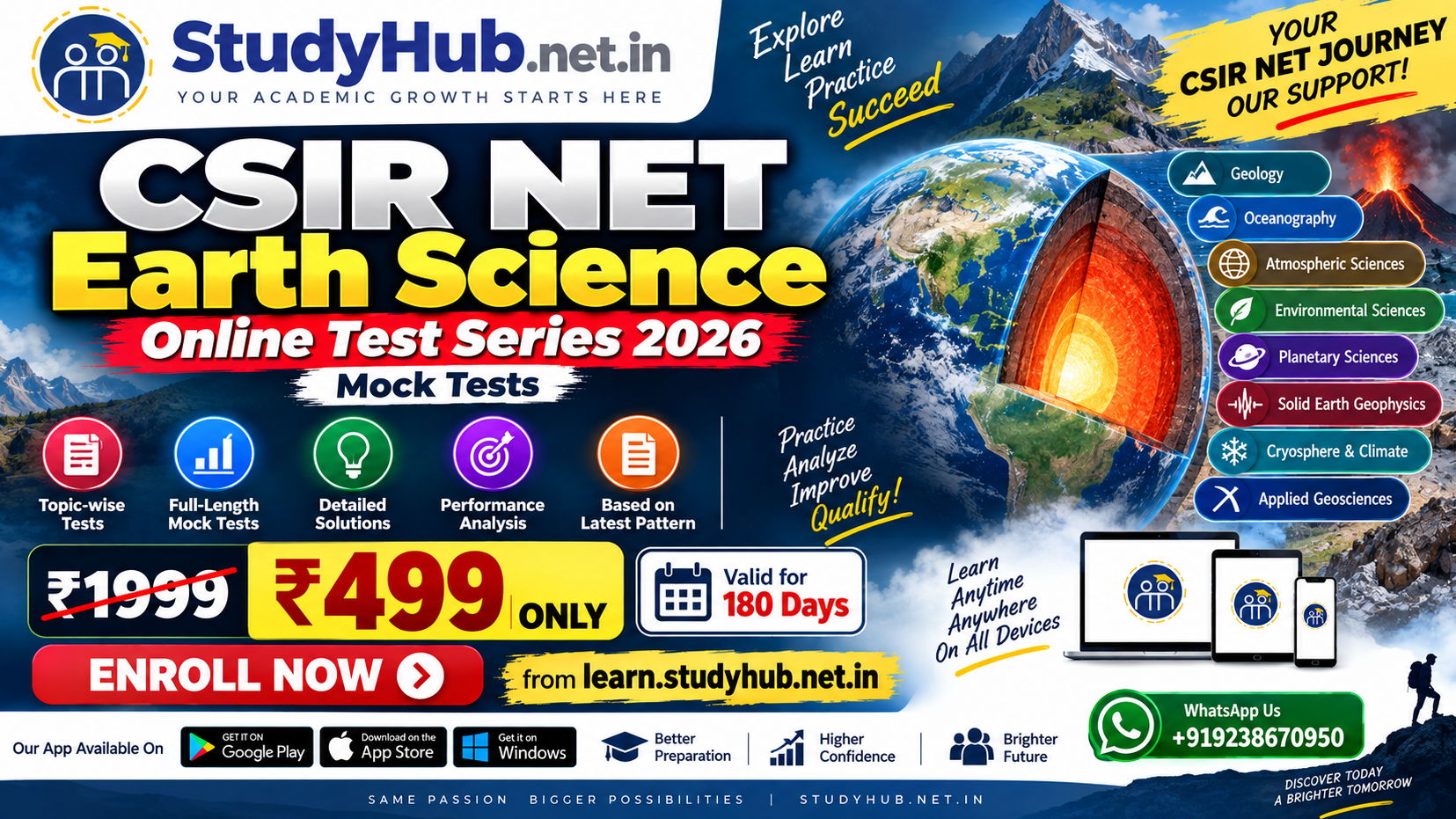
CSIR NET Earth Science 2026 Online Test Series | Mock Tests For: Geology, Applied Geology, Earth Sciences, Geophysics, Geochemistry, Atmospheric Science, Meteorology and other
Product information
- Number of chapters
- 32 Chapters
- Number of contents
- 150 Contents
- Course Validity
- Valid for 180 days
Crack the NTA CSIR NET Earth Science 2026 exam with our ultimate online test series. Get full-length mock tests, topic-wise practice, detailed solutions, and Part A coverage for JRF success. Enroll now! Test Series for: Passed or Appearing Students of M.Sc. Geology M.Sc. Applied Geology M.Sc. Earth Science / Earth Sciences M.Sc. Geophysics M.Sc. Applied Geophysics M.Sc. Geochemistry M.Sc. Atmospheric Science / Meteorology M.Sc. Oceanography / Marine Science Other closely related Earth/Atmospheric/Ocean/Planetary Science Master's degrees
CSIR NET Earth Science Online Test Series – Mock Tests, PYQs, Practice Tests & Complete Exam Preparation
Preparing for CSIR NET Earth Science is not just about reading Geology, Geophysics, Oceanography or Atmospheric Science from textbooks. To perform well in the actual examination, you need regular practice, a clear understanding of the exam pattern, strong command over concepts, problem-solving ability and, most importantly, the confidence to select the right questions under time pressure.
That is exactly what we aim to provide through our CSIR NET Earth Science Online Test Series. We have created this test series for students who are preparing for the CSIR-UGC NET Earth, Atmospheric, Ocean and Planetary Sciences examination and want consistent, exam-focused practice instead of studying without knowing where they stand.
Our course brings together topic-wise tests, subject-focused tests, CSIR NET practice tests, full-length mock tests, previous-year-question practice and selected study resources in one place. The goal is simple: help you practise more, understand your mistakes and enter the examination hall with a much stronger strategy.
CSIR NET Earth Science Test Series at a Glance
- 24 Chapters
- 88 Course Contents
- Topic-wise and subject-wise test practice
- CSIR NET Practice Tests
- 10 Full-Length CSIR NET Tests
- Dedicated tests for major Earth Science subjects
- Geology, Geophysics, Oceanography, Climatology and Aptitude practice
- Oceanography and Climatology study resources
- Previous-year-question based practice
- Online practice accessible through the StudyHUB learning platform
Why Choose Our CSIR NET Earth Science Online Test Series?
We understand that Earth Science preparation can become overwhelming because the syllabus covers a wide range of subjects. Students often complete one subject and then struggle to revise it, while others keep studying theory without testing whether they can actually solve examination-level questions.
Our CSIR NET Earth Science Mock Test Series is designed to solve this exact problem. Instead of studying randomly, you can move through your preparation in a more structured way — study a topic, attempt a test, identify your mistakes, revise the weak area and then move ahead.
Our focus is not simply on giving you a large number of questions. We want your practice to have a purpose.
Practice Before the Exam – Not After the Syllabus
You do not need to wait until every chapter is completed before starting test practice. Topic-wise tests allow you to begin evaluating your preparation while you are still covering the syllabus.
Understand Where You Are Losing Marks
A test score can reveal much more than your final marks. It can show whether you are struggling with concepts, calculations, factual recall, analytical questions, time management or question selection.
Build Real Exam Confidence
The more familiar you become with the structure and pressure of the examination, the easier it becomes to stay calm and focused when you finally sit for the real CSIR NET exam.
CSIR NET Earth Science Exam Pattern
Understanding the CSIR NET Earth Science exam pattern is essential because the paper contains three different sections, and each section tests you in a different way.
The official Earth, Atmospheric, Ocean and Planetary Sciences paper is a single-paper MCQ examination of 3 hours carrying a maximum of 200 marks. The question paper is divided into Part A, Part B and Part C. Candidates can attempt a maximum of 75 questions in total.
| Part | Total Questions | Questions to Attempt | Marks per Correct Answer | Negative Marking | Maximum Marks |
|---|---|---|---|---|---|
| Part A | 20 | 15 | 2 | -0.5 | 30 |
| Part B | 50 | 35 | 2 | -0.5 | 70 |
| Part C | 80 | 25 | 4 | -1.32 | 100 |
| Total | 150 | 75 | — | — | 200 |
Note: Part A and Part B carry 25% negative marking, while Part C carries 33% negative marking. The official scheme also explains that Part C is intended to test application of scientific concepts and analytical problem-solving.
Part A – General Aptitude
Part A is common to the CSIR NET science papers and focuses on areas such as General Science, Quantitative Reasoning, Analysis and Research Aptitude.
There are 20 questions, out of which candidates can attempt 15 questions. Each correct answer carries 2 marks.
Many Earth Science students concentrate heavily on their subject preparation and do not give enough attention to aptitude. We recommend regular Part A practice because even a relatively small improvement in this section can make a meaningful difference to your overall score.
Part B – Core Earth Science
Part B contains 50 subject-related MCQs, out of which candidates can attempt 35 questions. Each correct answer carries 2 marks.
This section tests your fundamental understanding of the subject. It can involve direct questions, conceptual questions and foundational knowledge from different areas of Earth Science.
Our topic-wise tests are particularly useful for Part B because they allow you to strengthen individual subjects before moving towards mixed and full-length tests.
Part C – Analytical and Application-Based Earth Science
Part C is where strong conceptual understanding and problem-solving ability become especially important.
The section contains 80 questions, from which candidates can attempt 25 questions. Each correct answer carries 4 marks, making Part C worth 100 marks out of the total 200.
Part C is designed to test your ability to apply scientific concepts to solve problems. This means memorising facts alone is not enough. You need to understand the concept, analyse the information given in the question and reach the correct conclusion.
This is one of the main reasons why regular practice with CSIR NET Earth Science mock tests and previous year questions is so important.
Major CSIR NET Earth Science Syllabus Areas Covered
Earth Science is a broad subject, and our test series is built around the major areas students need to practise for the examination.
Geology
Our course includes focused practice in important areas of Geology such as:
- Structural Geology
- Indian Stratigraphy
- Mineralogy
- Crystallography
- Igneous Petrology
- Metamorphic Petrology
- Sedimentology
- Palaeontology
- Geomorphology
- Economic Geology
- Ore Geology
- Engineering Geology
- Hydrogeology
These tests help you revise important geological concepts and practise the kind of questions that demand both factual knowledge and conceptual understanding.
Geochemistry
Geochemistry is an important component of Earth Science preparation. Our test structure includes Geochemistry practice tests to help students strengthen their understanding and problem-solving ability in this area.
Geophysics and Exploration Methods
For students preparing for the Geophysics component of CSIR NET Earth Science, regular numerical and conceptual practice is essential.
Our course includes practice related to:
- Earth and planetary motion
- Gravity methods
- Magnetic methods
- Electrical and electromagnetic methods
- Seismic methods
- Geophysical exploration
- Well logging
- Signal-related concepts and numerical practice
These tests are especially helpful for students who need more practice with calculations and application-based questions.
Oceanography
Our Oceanography section for CSIR NET Earth Science includes study and practice resources covering important topics such as:
- Introduction to Planet Earth and the Ocean
- Origin of Earth's Atmosphere
- Marine Provinces
- Deep Ocean Basin Features
- Marine Sediments
- Water and Sea Water
- Ocean Circulation
- The Monsoon
- Waves and Water Dynamics
Students can use these resources alongside the Oceanography tests for better revision and concept reinforcement.
Climatology and Atmospheric Science
The Climatology section provides focused preparation in areas including:
- Earth's Atmosphere
- Warming of the Earth and the Atmosphere
- Distribution of Temperature
- Humidity and Condensation
- Clouds
- Air Pressure and Winds
- Atmospheric Circulation
- Air Masses and Fronts
- Mid-Latitude Cyclones
- Air Pollution
- Climate and the Environment
Our CSIR NET Climatology practice tests help students revise these topics through focused question practice instead of depending only on passive reading.
Aptitude
We also include dedicated Aptitude Tests to help you practise the general aptitude portion of the examination.
Topic-Wise CSIR NET Earth Science Tests
One of the strongest features of our preparation system is subject-wise and topic-wise practice.
Our course includes dedicated tests for subjects such as:
- Structural Geology
- Geochemistry
- Earth and Planetary Motion
- Geophysics
- Mineralogy and Crystallography
- Palaeontology
- Metamorphic Petrology
- Sedimentology
- Geomorphology
- Indian Stratigraphy
- Igneous Petrology
- Engineering Geology
- Hydrogeology
- Ore Geology
- Remote Sensing
- Oceanography
- Climatology
- Aptitude
This structure allows you to concentrate on one subject at a time, identify weak chapters and gradually build confidence across the complete syllabus.
CSIR NET Earth Science Previous Year Questions and PYQ Practice
Previous Year Questions (PYQs) are one of the most useful tools for understanding how CSIR NET asks questions.
Instead of relying entirely on predicted questions, we encourage students to study the patterns that have appeared in previous examinations. Our course includes CSIR NET Earth Science PYQ-based practice to help students become familiar with the style and level of actual examination questions.
Practising previous year questions helps you understand:
- Which concepts are repeatedly tested
- How a familiar topic can be asked in a different way
- The level of conceptual depth expected in the exam
- The difference between direct and analytical questions
- How much calculation or reasoning may be required
- Which areas deserve more revision
For serious aspirants, solving PYQs should not be treated as the final step of preparation. They should be part of your preparation throughout the journey.
CSIR NET Full-Length Mock Tests
After topic-wise preparation, you need to practise the complete paper. That is why our course includes 10 CSIR NET Full-Length Tests.
Full-length tests allow you to experience the complete examination structure and practise making decisions across Part A, Part B and Part C.
These tests can help you improve:
- Time management
- Question selection
- Accuracy
- Speed
- Concentration
- Section-wise strategy
- Handling negative marking
- Exam-day confidence
Why Full-Length Mock Tests Matter for CSIR NET Earth Science
It is very common for students to score well in topic-wise tests and then struggle in a complete mock test. The reason is simple: the actual examination does not come chapter by chapter.
In the real CSIR NET exam, you have to switch between subjects, decide which questions are worth attempting, manage your time and avoid unnecessary negative marks.
Our CSIR NET Earth Science Full Test Series gives you an opportunity to build those skills before the actual examination.
How Our CSIR NET Earth Science Test Series Can Help You Prepare Better
1. Study and Test at the Same Time
You do not need to separate your learning and testing completely. After finishing a topic, take the relevant test and immediately check your level of understanding.
2. Identify Weak Topics Early
Regular testing helps you discover weak areas while there is still enough time to work on them.
3. Improve Your Accuracy
Because the examination has negative marking, accuracy matters. Repeated practice helps you understand when to attempt a question and when to leave it.
4. Improve Your Speed
Practice makes calculations, concepts and question interpretation faster. This becomes particularly important when handling Part C questions.
5. Develop Better Question Selection
You do not have to solve every question in the actual examination. You have to solve the right questions. Mock tests help you develop this skill through experience.
6. Strengthen Analytical Thinking
Earth Science questions can require interpretation, calculation and application of concepts. Regular practice helps you move beyond simple memorisation.
7. Build a Consistent Preparation Routine
A test series gives you a reason to keep testing yourself instead of studying passively for weeks without measuring your progress.
Who Can Enrol in This CSIR NET Earth Science Test Series?
Our CSIR NET Earth Science Online Test Series is suitable for students from different Earth Science and related academic backgrounds who are preparing for competitive examinations.
- CSIR NET Earth Science aspirants
- CSIR NET Earth, Atmospheric, Ocean and Planetary Sciences aspirants
- CSIR NET JRF Earth Science aspirants
- Geology students
- Geophysics students
- Earth Science students
- Applied Geology students
- Students preparing in Oceanography
- Students preparing in Atmospheric Science
- Students studying Climatology
- Students working on Geochemistry
- Students from related Earth and Environmental Science backgrounds
- Students preparing for GATE Geology and Geophysics (GG)
- GATE GG aspirants looking for additional Earth Science practice
- Students preparing for GSI-related examinations
- Repeaters preparing for another CSIR NET attempt
- Students who want additional practice after completing their syllabus
- Students who want CSIR NET Earth Science mock tests and PYQs in one place
Useful for GATE Geology and Geophysics Preparation
Several areas covered in this course overlap strongly with preparation required for GATE Geology and Geophysics (GG), particularly in subjects such as Structural Geology, Geophysics, Economic Geology and related Earth Science topics.
For students preparing for both examinations, this creates an additional advantage because the same conceptual practice can support preparation across multiple competitive examinations.
Study Resources for Oceanography and Climatology
Along with test practice, our course page includes additional learning resources for Oceanography and Climatology.
Oceanography resources cover topics such as ocean circulation, marine sediments, seawater, ocean basins, waves and water dynamics, while Climatology resources include atmospheric structure, temperature distribution, humidity, clouds, winds, circulation, air masses, cyclones, pollution and climate-related topics.
These materials can be used alongside the tests for revision and better conceptual preparation.
Our Recommended Strategy for CSIR NET Earth Science Preparation
Start with Topic-Wise Practice
Do not jump directly into full-length papers. First strengthen individual subjects through focused tests.
Move to Mixed Practice
Once you are comfortable with individual subjects, start mixing concepts from different areas. This helps prepare your mind for the interdisciplinary nature of the actual paper.
Solve Previous Year Questions
Use PYQs to understand the actual examination trend and identify concepts that deserve special attention.
Attempt Full-Length Mock Tests
Once your preparation is reasonably strong, start taking full papers under timed conditions.
Analyse Every Test
Your test is most useful after you finish it. Spend time identifying why you got a question wrong and what needs to change before your next attempt.
Repeat Weak Topics
Return to the subjects where your performance is consistently weak. This cycle of testing, analysing and revising is one of the most effective ways to improve.
What Makes Our CSIR NET Earth Science Test Series Different?
We have built this course around the way students actually prepare for a difficult competitive examination.
Instead of giving you only a collection of random mock papers, we provide a combination of:
- Subject-wise tests for focused preparation
- Topic-wise practice for concept strengthening
- CSIR NET PYQ practice for understanding previous examination trends
- Aptitude tests for Part A preparation
- CSIR NET practice tests for regular revision
- Full-length mock tests for complete exam simulation
- Oceanography resources for focused revision
- Climatology resources for atmospheric science preparation
This gives you the flexibility to use the course at different stages of your preparation — from your first revision to your final mock-test phase.
Frequently Asked Questions About CSIR NET Earth Science Test Series
Is this test series useful for CSIR NET Earth Science preparation?
Yes. The course is specifically structured around Earth Science preparation and includes subject-wise tests, CSIR NET practice tests, PYQ-based practice and full-length tests covering major areas of the syllabus.
Does the course include CSIR NET Earth Science mock tests?
Yes. The course includes dedicated CSIR NET Mock Tests and 10 full-length tests for complete examination practice.
Does it include Previous Year Questions?
Yes. The course includes CSIR NET Earth Science PYQ-based practice to help you understand previous examination questions and trends.
Can Geology students use this course?
Yes. Geology students can use the dedicated tests for Structural Geology, Mineralogy, Petrology, Sedimentology, Palaeontology, Geomorphology, Indian Stratigraphy, Economic Geology and other related areas.
Can Geophysics students use this test series?
Yes. The course includes practice in Geophysics and exploration-related areas, making it useful for students who are preparing from a Geophysics background.
Is there Aptitude practice?
Yes. Dedicated Aptitude tests are included to help students practise the General Aptitude portion of the CSIR NET examination.
Is this course useful for GATE GG preparation?
Yes. Several of the covered Earth Science subjects overlap with GATE Geology and Geophysics preparation, so the practice can provide additional value for GATE GG aspirants.
Course Details
- Course: CSIR NET Earth Science Online Test Series
- Subject: Earth, Atmospheric, Ocean and Planetary Sciences
- Chapters: 24
- Total Contents: 88
- CSIR NET Full Tests: 10
- Topic-Wise Tests: Included
- NET Practice Tests: Included
- PYQ-Based Practice: Included
- Oceanography Resources: Included
- Climatology Resources: Included
Prepare for CSIR NET Earth Science with a Smarter Test Strategy
CSIR NET Earth Science is a competitive examination, and simply reading more books does not automatically guarantee a better score. What matters is how well you can understand, remember, apply and use your knowledge when you are under exam pressure.
With our CSIR NET Earth Science Online Test Series, you can turn your preparation into a regular cycle of practice → test → analysis → revision → improvement.
Strengthen your Geology. Improve your Geophysics. Revise Oceanography and Climatology. Practise Aptitude. Solve previous-year questions. Take full-length tests. Analyse your performance.
That is how we recommend preparing for a serious attempt at CSIR NET Earth Science.
Join Our CSIR NET Earth Science Online Test Series Today
If you are preparing for CSIR NET Earth Science, CSIR NET JRF Earth Science, Earth Atmospheric Ocean and Planetary Sciences, Geology, Geophysics, Oceanography, Climatology or related Earth Science examinations, our online test series gives you a structured way to practise and measure your preparation.
Topic-Wise Tests + PYQ Practice + Aptitude Tests + CSIR NET Practice Tests + 10 Full-Length Mock Tests + Oceanography & Climatology Resources
Start practising today and make every test a step towards a better CSIR NET score.