
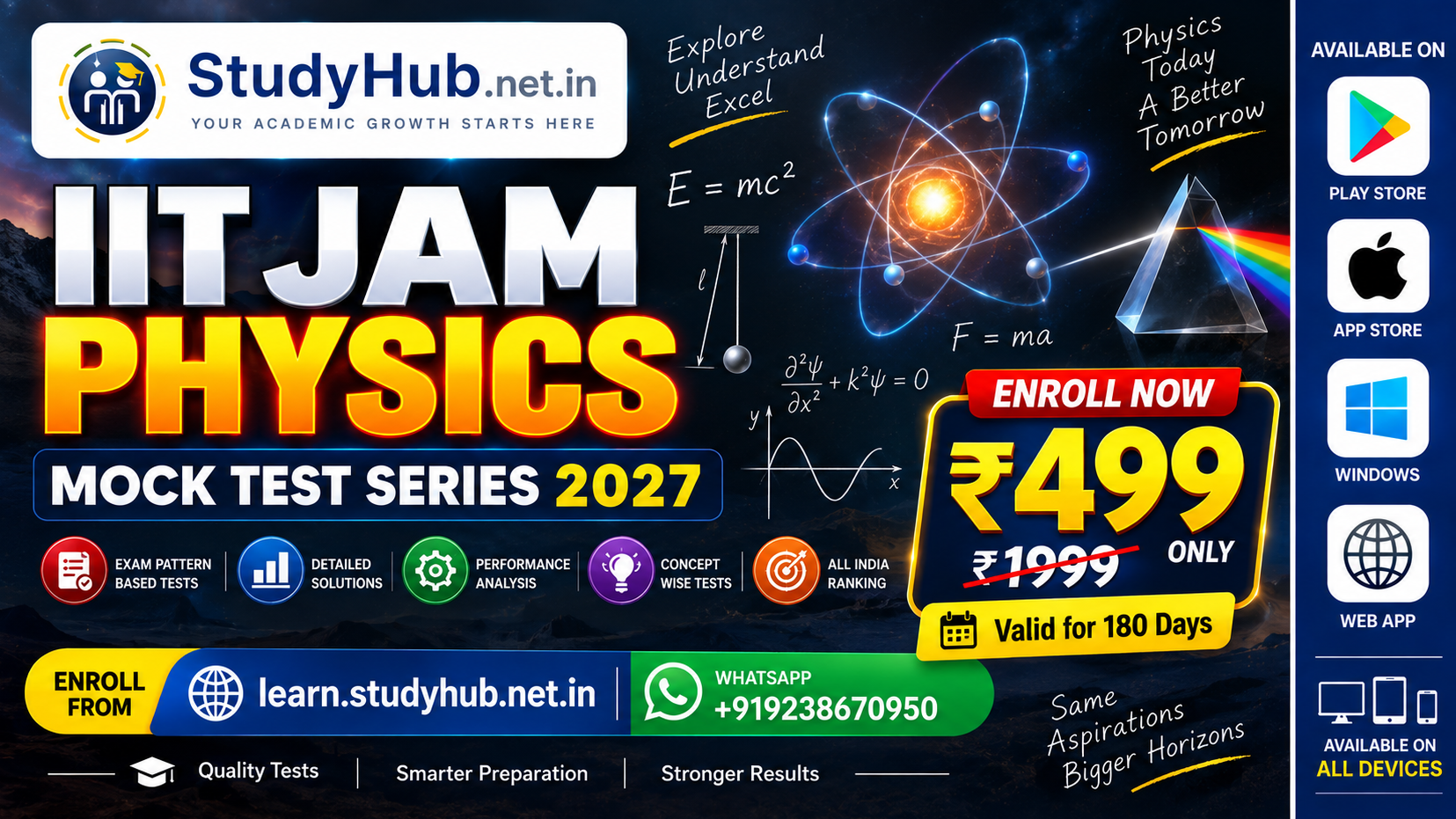
IIT JAM PHYSICS Mock Test Series
Product information
- Number of chapters
- 3 Chapters
- Number of contents
- 17 Contents
- Course Validity
- Valid for 180 days
IIT JAM Physics Mock Test Series – Full-Length Tests, Unit Tests & Complete Syllabus Practice
IIT JAM Physics Mock Test Series – Full-Length Tests, Unit Tests & Complete Syllabus Practice
Preparing for IIT JAM Physics is not just about studying formulas and solving a few questions from your textbook. The actual examination checks how well you understand Physics concepts, how quickly you can apply them, how accurately you can calculate and how confidently you can handle different question formats under a strict time limit.
That is why we have designed our IIT JAM Physics Mock Test Series for students who want serious, exam-oriented practice before the IIT JAM examination.
Our online test series brings together 8 Unit-Wise Tests, 6 Full-Length Tests and 3 IIT JAM Physics Mock Tests covering the major areas of the official Physics syllabus. You can use these tests while completing the syllabus, during revision and in the final phase of your IIT JAM preparation. The course currently includes 17 test contents and has 180 days validity.
Whether you are appearing for IIT JAM Physics for the first time or preparing for another attempt, our aim is to help you practise consistently, identify your weak areas, improve your speed and accuracy, and become comfortable with the actual examination environment.
IIT JAM Physics Test Series – Course Highlights
- 3 Chapters
- 17 Total Contents
- 8 Unit-Wise Tests
- 6 Full-Length Tests
- 3 IIT JAM Physics Mock Tests
- Practice across the major IIT JAM Physics syllabus areas
- 180 Days Course Validity
- Online test practice for IIT JAM Physics aspirants
Special Offer on IIT JAM Physics Mock Test Series
Original Price: ₹1,999
Offer Price: ₹499
Get the complete IIT JAM Physics Mock Test Series for just ₹499 and make your preparation more structured, practical and exam-focused.
What Makes Our IIT JAM Physics Test Series Useful?
Physics is a subject where understanding a formula is only the first step. In a competitive examination like IIT JAM, you have to know when to use the formula, why to use it and how to reach the answer quickly.
A student may understand Classical Mechanics but still lose marks because of a calculation error. Another student may know Electromagnetism well but spend too much time on one difficult question. Someone else may complete Thermodynamics but struggle when concepts are mixed with numerical problems.
Regular testing helps solve these problems.
Our test series is designed around a simple preparation cycle:
Learn → Practise → Test → Analyse → Revise → Retest → Improve
Instead of studying for months without knowing your actual preparation level, you can continuously test yourself and make your preparation more targeted.
IIT JAM Physics Exam Pattern
The IIT JAM Physics examination is conducted as a Computer Based Test. The paper has 60 questions carrying a total of 100 marks, and the examination duration is 3 hours. The paper is divided into Section A, Section B and Section C, and all three sections are compulsory.
| Section | Question Type | Total Questions | Marks | Negative Marking |
|---|---|---|---|---|
| Section A | MCQ – Multiple Choice Questions | 30 | 50 | Yes |
| Section B | MSQ – Multiple Select Questions | 10 | 20 | No |
| Section C | NAT – Numerical Answer Type | 20 | 30 | No |
| Total | MCQ + MSQ + NAT | 60 | 100 | — |
Section A – MCQ
Section A contains 30 Multiple Choice Questions. Each question has four options and only one correct answer.
Questions 1 to 10 carry 1 mark each, while Questions 11 to 30 carry 2 marks each. Therefore, Section A carries a total of 50 marks.
Negative marking applies in this section:
- 1-mark question: 1/3 mark is deducted for an incorrect answer.
- 2-mark question: 2/3 mark is deducted for an incorrect answer.
Because of negative marking, accuracy and question selection become very important in Section A.
Section B – MSQ
Section B contains 10 Multiple Select Questions, with each question carrying 2 marks.
One or more options may be correct. You receive full credit only when you select all the correct choices and do not select any incorrect choice.
There is no negative marking and no partial marking in Section B.
Section C – NAT
Section C contains 20 Numerical Answer Type questions. No options are provided for these questions. You have to enter the numerical answer using the virtual keyboard.
Questions 41 to 50 carry 1 mark each, while Questions 51 to 60 carry 2 marks each, making Section C worth 30 marks.
There is no negative marking in Section C.
Why Practising MCQ, MSQ and NAT Is Important for IIT JAM Physics
Each question type requires a different approach.
In MCQs, you need speed, option elimination and accuracy because of negative marking.
In MSQs, you need to analyse every option carefully because more than one option can be correct and there is no partial marking.
In NAT questions, you need confidence in your calculations because no options are given.
This is why solving random Physics questions is not enough. You should practise questions in the same formats that you will face in IIT JAM.
Complete IIT JAM Physics Syllabus
The official IIT JAM 2026 Physics syllabus consists of 7 sections. These sections cover the major areas of Physics required for the JAM Physics paper.
Section 1 – Mathematical Methods
Mathematical Methods form the foundation for many topics in Physics. A strong command over these concepts can make problem-solving much easier in Mechanics, Electromagnetism, Waves, Thermodynamics and Modern Physics.
Calculus and Multivariable Calculus
- Calculus of single variables
- Calculus of multiple variables
- Partial derivatives
- Jacobian
- Imperfect and perfect differentials
- Taylor expansion
- Fourier series
- Multiple integrals
Vector Algebra and Vector Calculus
- Vector algebra
- Vector calculus
- Divergence theorem
- Green's theorem
- Stokes' theorem
Differential Equations
- First-order differential equations
- Linear second-order differential equations with constant coefficients
Matrices, Determinants and Complex Numbers
- Matrices
- Determinants
- Complex numbers
Error Analysis of Experimental Data
- Significant digits
- Rounding of numbers
- Types of errors
- Mean
- Median
- Standard deviation
Section 2 – Mechanics and General Properties of Matter
Mechanics is one of the most important areas for IIT JAM Physics preparation. Questions can involve direct concepts, mathematical applications and multi-step numerical problems.
Newtonian Mechanics
- Newton's laws of motion
- Applications of Newton's laws
- Velocity and acceleration in Cartesian coordinates
- Velocity and acceleration in polar coordinates
- Velocity and acceleration in cylindrical coordinates
- Uniformly rotating frames
- Centrifugal force
- Coriolis force
Central Force Motion and Gravitation
- Motion under a central force
- Kepler's laws
- Gravitational law
- Gravitational field
- Conservative forces
- Non-conservative forces
System of Particles
- System of particles
- Centre of mass
- Equation of motion of the centre of mass
- Conservation of linear momentum
- Conservation of angular momentum
- Conservation of energy
- Variable mass systems
Collisions
- Elastic collisions
- Inelastic collisions
Rigid Body Dynamics
- Rigid body motion
- Fixed-axis rotation
- Rotation and translation
- Moments of inertia
- Products of inertia
- Parallel axis theorem
- Perpendicular axis theorem
- Principal moments
- Principal axes
Fluid Mechanics
- Kinematics of moving fluids
- Equation of continuity
- Euler's equation
- Bernoulli's theorem
Section 3 – Oscillations, Waves and Optics
This section combines Oscillations, Wave Physics and Optics. Regular numerical practice is important because the same basic concept can appear in several different forms in the examination.
Oscillations
- Differential equation for a simple harmonic oscillator
- General solution of the simple harmonic oscillator
- Superposition of two or more simple harmonic oscillators
- Lissajous figures
- Damped oscillations
- Forced oscillations
- Resonance
Waves
- Wave equation
- Travelling waves in one dimension
- Standing waves in one dimension
- Energy density in waves
- Energy transmission in waves
- Group velocity
- Phase velocity
- Sound waves in media
- Doppler effect
Optics
- Fermat's principle
- General theory of image formation
- Interference of light
- Optical path retardation
- Fraunhofer diffraction
- Rayleigh criterion
- Resolving power
- Diffraction gratings
- Linear polarization
- Circular polarization
- Elliptic polarization
- Double refraction
- Optical rotation
Section 4 – Electricity and Magnetism
Electricity and Magnetism is another major area of IIT JAM Physics preparation. It requires both conceptual clarity and strong numerical practice.
Electrostatics
- Coulomb's law
- Electric field
- Electric potential
- Gauss's law
- Electrostatic boundary conditions
- Solution of Laplace's equation for simple cases up to two dimensions
Conductors, Capacitors and Dielectrics
- Conductors
- Capacitors
- Linear dielectrics
- Dielectric polarization
- Volume bound charges
- Surface bound charges
- Electrostatic energy
Magnetism and Electromagnetic Induction
- Biot-Savart law
- Ampere's law
- Faraday's law of electromagnetic induction
- Self-inductance
- Mutual inductance
DC and AC Circuits
- Alternating currents
- Simple DC circuits
- Simple AC circuits
- R, L and C components
Maxwell's Equations and Electromagnetic Waves
- Displacement current
- Maxwell's equations
- Plane electromagnetic waves
- Poynting vector
- Poynting's theorem
- Energy of electromagnetic fields
Electromagnetic Waves and Charged Particles
- Reflection at a dielectric interface
- Refraction at a dielectric interface
- Transmission coefficients at normal incidence
- Reflection coefficients at normal incidence
- Lorentz force
- Motion of charged particles in electric fields
- Motion of charged particles in magnetic fields
Section 5 – Kinetic Theory and Thermodynamics
Thermodynamics is an important part of the IIT JAM Physics syllabus. Questions may combine conceptual understanding with numerical calculations and thermodynamic relations.
Kinetic Theory of Gases
- Elements of kinetic theory of gases
- Velocity distribution
- Equipartition of energy
- Specific heat of monoatomic gases
- Specific heat of diatomic gases
- Specific heat of triatomic gases
- Ideal gas
- van der Waals gas
- Equation of state
- Mean free path
Laws of Thermodynamics
- Zeroth law of thermodynamics
- Thermal equilibrium
- First law of thermodynamics
- Consequences of the first law
- Isothermal processes
- Adiabatic processes
- Reversible processes
- Irreversible processes
- Quasi-static processes
- Second law of thermodynamics
- Entropy
- Carnot cycle
Thermodynamic Relations and Statistical Ideas
- Maxwell's thermodynamic relations
- Applications of Maxwell's relations
- Thermodynamic potentials
- Applications of thermodynamic potentials
- Phase transitions
- Clausius-Clapeyron equation
- Basic idea of ensembles
- Maxwell-Boltzmann distribution
- Fermi-Dirac distribution
- Bose-Einstein distribution
Section 6 – Modern Physics
Modern Physics includes Special Relativity, Quantum Physics, Atomic Physics and Nuclear Physics. Strong conceptual understanding is essential for solving questions efficiently.
Special Relativity
- Inertial frames
- Galilean invariance
- Postulates of special relativity
- Lorentz transformations
- Length contraction
- Time dilation
- Relativistic velocity addition theorem
- Mass-energy equivalence
Quantum and Radiation Physics
- Blackbody radiation
- Photoelectric effect
- Compton effect
- Bohr's atomic model
- X-rays
- Wave-particle duality
- Uncertainty principle
- Superposition principle
- Calculation of expectation values
Quantum Mechanics
- Schrödinger equation
- Solution of Schrödinger equation for one-dimensional box
- Solution for two-dimensional box
- Solution for three-dimensional box
- One-dimensional harmonic oscillator
- Reflection at a step potential
- Transmission at a step potential
- Pauli exclusion principle
Nuclear Physics
- Structure of the atomic nucleus
- Mass and binding energy
- Radioactivity
- Applications of radioactivity
- Laws of radioactive decay
Section 7 – Solid State Physics, Devices and Electronics
This section brings together Solid State Physics, Semiconductor Devices and basic Electronics. It is important to practise both conceptual questions and numerical applications.
Solid State Physics
- Crystal structure
- Bravais lattices
- Basis
- Miller indices
- X-ray diffraction
- Bragg's law
Semiconductors
- Intrinsic semiconductors
- Extrinsic semiconductors
- Variation of resistivity with temperature
- Fermi level
Diodes and Transistors
- p-n junction diode
- I-V characteristics
- Zener diode
- Applications of Zener diode
- BJT characteristics in CB mode
- BJT characteristics in CE mode
- BJT characteristics in CC mode
Amplifiers and Oscillators
- Single-stage amplifier
- Two-stage R-C coupled amplifiers
- Simple oscillators
- Barkhausen condition
- Sinusoidal oscillators
Operational Amplifier
- OPAMP
- Inverting amplifier
- Non-inverting amplifier
- Applications of OPAMP
Digital Electronics
- Boolean algebra
- Binary number systems
- Conversion from one number system to another
- Binary addition
- Binary subtraction
- AND gate
- OR gate
- NOT gate
- NAND gate
- NOR gate
- Exclusive OR gate
- Truth tables
- Combination of logic gates
- De Morgan's theorem
The above syllabus is based on the official IIT JAM 2026 Physics syllabus supplied by IIT Bombay.
8 Unit-Wise IIT JAM Physics Tests
Our course includes 8 Unit-Wise Tests, allowing you to test your preparation subject by subject instead of waiting until the entire syllabus is completed.
The current course includes focused tests for:
- Unit Test 1 – Classical Mechanics
- Unit Test 2 – Mathematical Physics
- Unit Test 3 – EMT
- Unit Test 4 – Solid State & Electronics
- Unit Test 5 – Wave & Optics
- Unit Test 6 – Kinetic Theory & Thermodynamics
- Unit Test 7 – Modern Physics
- Unit Test 8 – Devices & Electronics
These unit-wise tests are useful after completing an individual topic or during your first and second revision. Instead of simply reading your notes again, you can check whether you are actually able to solve questions from that topic.
6 Full-Length IIT JAM Physics Tests
Our course includes 6 Full-Length Tests designed to help you practise the complete IIT JAM Physics paper.
Full-length testing is important because the real examination does not come chapter by chapter. You may get a Mechanics question followed by Optics, Electromagnetism, Thermodynamics, Modern Physics or Electronics.
These tests help you practise:
- Complete-syllabus problem solving
- Time management
- Question selection
- MCQ accuracy
- MSQ option analysis
- NAT numerical solving
- Calculation speed
- Maintaining concentration for the complete examination
The course currently lists Full Test 1 through Full Test 6.
3 IIT JAM Physics Mock Tests
Along with unit-wise and full-length tests, we have included 3 dedicated IIT JAM Physics Mock Tests. These provide additional exam-oriented practice and help you build confidence before the actual paper.
You can use these mock tests in the final phase of preparation to check your overall readiness and practise solving Physics questions under a fixed time limit.
Why IIT JAM Physics Previous Year Papers and Practice Questions Matter
Even when you understand a chapter thoroughly, the examination may present the same concept in a completely different form.
For example, knowing the formula for a harmonic oscillator does not automatically mean you will solve every oscillation problem correctly. Similarly, knowing Gauss's law is different from knowing when and how to use it efficiently in a given problem.
This is why regular practice is so important.
Solving exam-oriented questions can help you:
- Understand the level of problems expected in IIT JAM Physics
- Recognise commonly tested concepts
- Improve calculation speed
- Reduce conceptual mistakes
- Develop better question-selection skills
- Become more comfortable with numerical problems
Why Mock Tests Are Important for IIT JAM Physics Preparation
Many students study Physics for months but start mock tests only a few days before the exam. That is not an ideal strategy.
A mock test should be used as a preparation tool, not just as a final assessment.
Test Your Real Preparation
A mock test tells you whether you can actually apply what you have studied.
Find Weak Areas
If your performance is repeatedly weak in Electromagnetism, Thermodynamics or Mathematical Methods, you know exactly where to focus your revision.
Improve Accuracy
Repeated practice helps you identify calculation errors, sign mistakes, unit mistakes and conceptual confusion.
Improve Speed
Solving more problems helps you recognise familiar patterns quickly, which can save valuable time during the examination.
Develop Question Selection Skills
You do not need to solve every question. You need to solve the right questions within the available time.
Build Exam Confidence
The more papers you solve before the actual examination, the less unfamiliar the exam environment will feel.
Who Can Enrol in Our IIT JAM Physics Mock Test Series?
Our IIT JAM Physics Online Test Series is suitable for students from different Physics backgrounds who are preparing for the JAM Physics paper.
- IIT JAM Physics aspirants
- IIT JAM PH aspirants
- B.Sc. Physics students
- B.Sc. Honours Physics students
- B.Sc. Mathematics and Physics students
- M.Sc. Physics entrance aspirants
- Physics stream students
- Students preparing for postgraduate Physics admissions
- Students preparing for IIT JAM for the first time
- Repeaters preparing for another IIT JAM attempt
- Students who have completed the syllabus and want intensive practice
- Students who are still completing the syllabus and want unit-wise testing
Who Should Prepare for IIT JAM Physics?
If you have a strong interest in Physics and want to pursue postgraduate study in Physics or a related discipline through programmes accepting IIT JAM scores, systematic preparation for the JAM Physics paper is essential.
Before applying, candidates should always check the eligibility requirements and programme-specific admission conditions of the institute and programme they are targeting.
How Our IIT JAM Physics Test Series Helps You Improve
1. Strengthen Your Concepts
Unit-wise testing helps you verify whether your concepts are actually clear.
2. Improve Numerical Practice
Physics cannot be mastered by reading alone. Regular problem-solving develops calculation confidence.
3. Reduce Silly Mistakes
Repeated testing helps identify patterns in the mistakes you keep making.
4. Improve Time Management
Timed tests train you to solve questions without spending too much time on a single problem.
5. Prepare for All Three Question Types
Regular practice helps you become comfortable with MCQs, MSQs and NAT questions.
6. Build a Better Exam Strategy
As you take more tests, you can understand which topics you are comfortable with and build an attempt strategy around your strengths.
IIT JAM Physics Preparation Strategy
Step 1 – Complete the Syllabus Systematically
Divide the official Physics syllabus into manageable sections and study one topic at a time.
Step 2 – Strengthen Mathematical Methods
Do not ignore Mathematics. Calculus, vectors, differential equations, matrices and error analysis support several other areas of Physics.
Step 3 – Practise After Every Major Topic
Once you complete a topic such as Mechanics, Optics or Thermodynamics, attempt a relevant test.
Step 4 – Keep Revising Weak Areas
Mark the concepts in which you repeatedly make mistakes and revisit them during your revision.
Step 5 – Attempt Full Tests
Move from unit tests to full-length tests once you are reasonably comfortable with the individual sections.
Step 6 – Use Mock Tests for Final Preparation
Use the dedicated mock tests to check your final readiness and practise the complete paper in an exam-like environment.
How to Improve Your IIT JAM Physics Score
A higher score is not always about studying more hours. It is often about improving the quality of your problem-solving.
Focus on:
- Strong fundamentals in Mathematical Physics
- Regular Mechanics problem practice
- Numerical practice in Electricity and Magnetism
- Good command over Oscillations, Waves and Optics
- Strong Thermodynamics concepts
- Regular Modern Physics revision
- Solid State and Electronics practice
- Speed in numerical calculations
- Careful MCQ attempts because of negative marking
- Regular MSQ and NAT practice
- Timed full-length mock tests
IIT JAM Physics Mock Tests for Final Revision
When the examination is approaching, reading the entire syllabus from the beginning again can become difficult.
Mock tests make your revision active.
A single full-length Physics test can take you across Mechanics, Mathematical Methods, Optics, Electromagnetism, Thermodynamics, Modern Physics and Electronics. Every incorrect answer can then become a revision point.
This makes mock tests useful not only for assessment but also for final revision and last-stage preparation.
Course Details
- Course Name: IIT JAM Physics Mock Test Series
- Paper: IIT JAM Physics (PH)
- Chapters: 3
- Total Contents: 17
- Unit-Wise Tests: 8
- Full-Length Tests: 6
- IIT JAM Physics Mock Tests: 3
- Course Validity: 180 Days
IIT JAM Physics Mock Test Series Price
Original Price: ₹1,999
Offer Price: ₹499
Get the complete IIT JAM Physics Mock Test Series for just ₹499 and practise Physics with a structured combination of unit tests, full-length papers and mock tests.
Frequently Asked Questions – IIT JAM Physics Test Series
What is the IIT JAM Physics Mock Test Series?
It is an online test series designed for students preparing for the IIT JAM Physics examination. The course includes unit-wise tests, full-length tests and dedicated mock tests covering the major Physics syllabus areas.
How many unit-wise tests are included?
The current course includes 8 Unit-Wise Tests covering Classical Mechanics, Mathematical Physics, EMT, Solid State & Electronics, Wave & Optics, Kinetic Theory & Thermodynamics, Modern Physics and Devices & Electronics.
How many full-length tests are included?
The course includes 6 Full-Length IIT JAM Physics Tests.
Are IIT JAM Physics mock tests included?
Yes. The course includes 3 dedicated IIT JAM Physics Mock Tests in addition to the unit-wise and full-length tests.
Does the test series cover the complete IIT JAM Physics syllabus?
The course is structured around the major areas of the official IIT JAM Physics syllabus, including Mathematical Methods, Mechanics, Oscillations and Waves, Optics, Electricity and Magnetism, Thermodynamics, Modern Physics, Solid State Physics and Electronics.
Is this test series suitable for B.Sc. Physics students?
Yes. B.Sc. Physics students preparing for IIT JAM can use the test series to practise the JAM-level problem-solving required across the Physics syllabus.
Is this useful for students preparing for IIT JAM Physics for the first time?
Yes. Beginners can start with the unit-wise tests and gradually move towards full-length tests and mock tests as their preparation improves.
Is this useful for repeaters?
Yes. Repeaters can use the tests to identify the topics that affected their previous performance and build a more measurable preparation strategy for their next attempt.
Prepare for IIT JAM Physics with Regular Test Practice
IIT JAM Physics rewards students who can combine conceptual understanding, mathematical ability, numerical practice, speed and accuracy.
Reading theory gives you the foundation. Solving problems turns that knowledge into examination skill.
Use our 8 Unit-Wise Tests to strengthen individual topics. Use the 6 Full-Length Tests to practise the complete syllabus. Use the 3 IIT JAM Physics Mock Tests to check your final preparation and improve your examination strategy.
Every test should help you answer three important questions:
What do I know?
Where am I making mistakes?
What should I improve before my next test?
Start Your IIT JAM Physics Preparation Today
8 Unit-Wise Tests + 6 Full-Length Tests + 3 IIT JAM Physics Mock Tests
180 Days Validity
Original Price: ₹1,999
Get the Complete IIT JAM Physics Test Series for Just ₹499
Prepare consistently. Practise more Physics problems. Analyse your mistakes. Improve your speed and accuracy.
Enrol today and make your IIT JAM Physics preparation more organised, practical and exam-focused.