
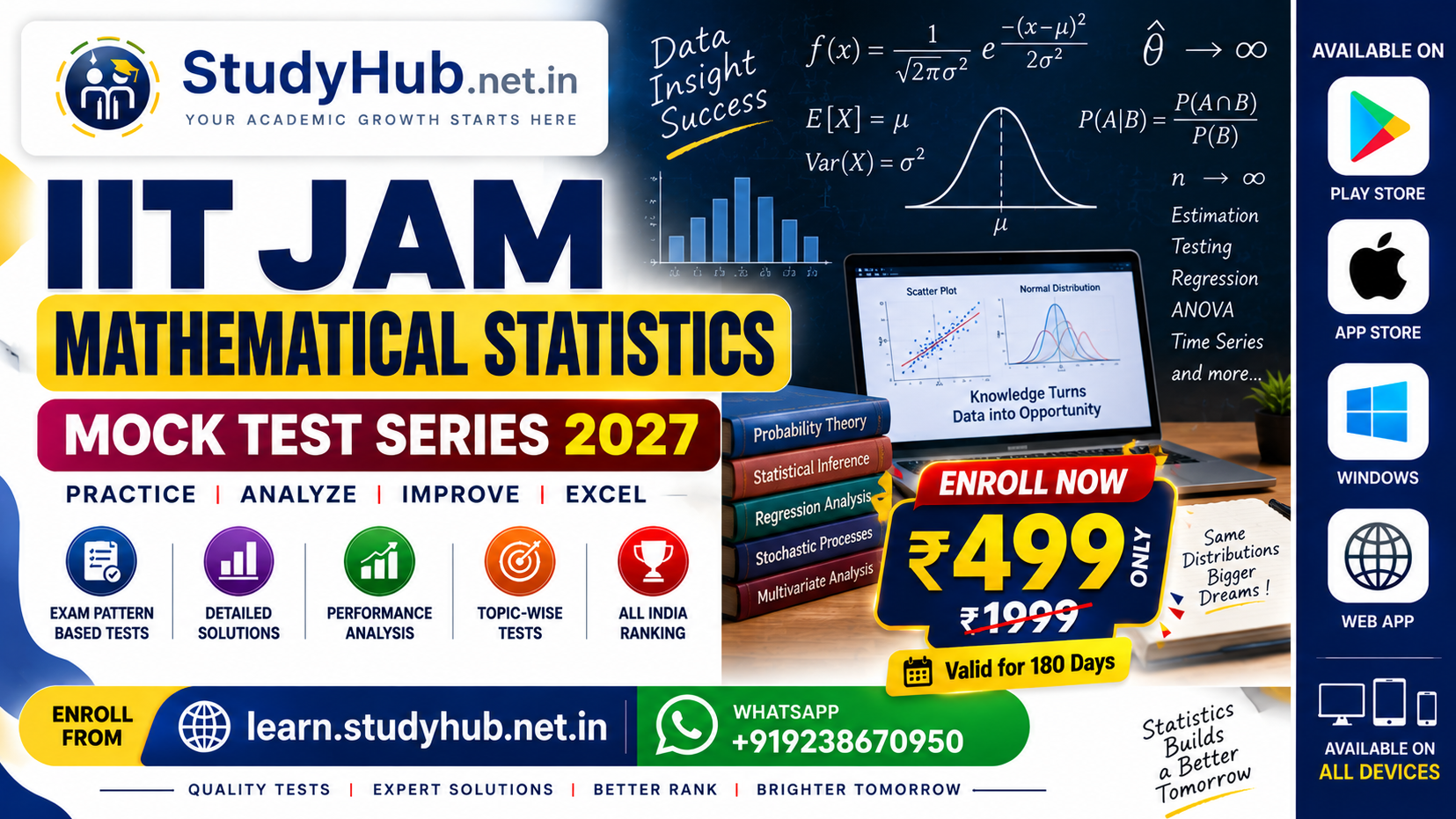
IIT JAM Mathematical Statistics Mock Test Series
Product information
- Number of chapters
- 3 Chapters
- Number of contents
- 26 Contents
- Course Validity
- Valid for 180 days
Start your IIT JAM Mathematical Statistics preparation with StudyHUB and turn your preparation into consistent, exam-focused practice. Start Your IIT JAM Mathematical Statistics Preparation Today Get the complete IIT JAM Mathematical Statistics Mock Test Series for just ₹499 instead of ₹1,999. Get access to 5 Unit-Wise Tests + 15 Full-Length Mock Tests + PYQ Tests from 2020–2025 and practice according to the actual IIT JAM MS exam pattern. Don't just study for IIT JAM — test your preparation, find your weak areas and improve before the exam. 👉 Enroll Now for ₹499 and Start Your IIT JAM Mathematical Statistics Test Preparation.
IIT JAM Mathematical Statistics Mock Test Series – Complete Mock Tests, PYQs & Full Syllabus Practice
Preparing for IIT JAM Mathematical Statistics (MS) requires a strong understanding of both Mathematics and Statistics, but understanding the syllabus is only the beginning. To perform well in the actual examination, you also need regular problem-solving practice, speed, accuracy, familiarity with the question pattern and the ability to handle MCQ, MSQ and NAT questions confidently.
That is why we have designed our IIT JAM Mathematical Statistics Mock Test Series for students who want serious, exam-focused practice before the IIT JAM examination.
Our online test series brings together unit-wise tests, 15 full-length mock tests and IIT JAM Mathematical Statistics Previous Year Question Paper (PYQ) mock tests in one place. You can use the tests while preparing the syllabus, during revision and especially during the final stages of your IIT JAM preparation.
Whether you are preparing for IIT JAM Mathematical Statistics for the first time or taking another attempt, our objective is to help you practise consistently, identify your weak areas, improve your problem-solving approach and become more comfortable with the actual examination pattern.
IIT JAM Mathematical Statistics Test Series – Course Highlights
- 3 Chapters
- 26 Total Contents
- 5 Unit-Wise Tests
- 15 Full-Length Tests
- 6 Previous Year Question Paper Mock Tests
- PYQ Mock Tests for IIT JAM Mathematical Statistics 2020, 2021, 2022, 2023, 2024 and 2025
- 180 Days Course Validity
- Online test practice for IIT JAM Mathematical Statistics aspirants
Special Price for IIT JAM Mathematical Statistics Test Series
Original Price: ₹1,999
Offer Price: ₹499
Get the complete IIT JAM Mathematical Statistics Mock Test Series for just ₹499 and make your preparation more practice-oriented and examination-focused.
Why Is an IIT JAM Mathematical Statistics Mock Test Series Important?
Preparing for IIT JAM Mathematical Statistics is very different from simply reading Mathematics and Statistics theory.
You may understand probability, distributions, calculus, matrices, estimation or hypothesis testing while studying, but the examination requires you to solve problems quickly and accurately. Sometimes the biggest challenge is not knowing the concept; it is recognising the correct approach within a limited amount of time.
The IIT JAM MS paper also contains three different question formats. You have to handle MCQs, MSQs and NAT questions, each requiring a slightly different approach.
That is where regular mock-test practice becomes important.
Our test series helps you build a preparation cycle of:
Learn → Practise → Test → Analyse → Revise → Retest → Improve
Instead of studying for months without measuring your performance, you can continuously check how well you are actually prepared.
IIT JAM Mathematical Statistics Exam Pattern
The IIT JAM Mathematical Statistics examination is conducted as a Computer Based Test. The paper has a duration of 3 hours, contains 60 questions and carries a maximum of 100 marks. The paper is divided into Section A, Section B and Section C. All three sections are compulsory.
| Section | Question Type | Total Questions | Total Marks | Negative Marking |
|---|---|---|---|---|
| Section A | MCQ – Multiple Choice Questions | 30 | 50 | Yes |
| Section B | MSQ – Multiple Select Questions | 10 | 20 | No |
| Section C | NAT – Numerical Answer Type | 20 | 30 | No |
| Total | MCQ + MSQ + NAT | 60 | 100 | — |
Section A – MCQ
Section A contains 30 Multiple Choice Questions with four options and one correct answer.
Questions 1 to 10 carry 1 mark each, while Questions 11 to 30 carry 2 marks each, making the section worth 50 marks.
Negative marking applies in this section:
- 1-mark MCQ: 1/3 mark is deducted for an incorrect answer.
- 2-mark MCQ: 2/3 mark is deducted for an incorrect answer.
This makes careful question selection extremely important. Blind guessing can reduce your score, so regular MCQ practice is essential.
Section B – MSQ
Section B contains 10 Multiple Select Questions, with each question carrying 2 marks.
One or more options can be correct. You receive full credit only when you select all the correct options and no incorrect option.
There is no negative marking and no partial marking in Section B.
MSQ questions require a different kind of preparation because you must evaluate all the options carefully instead of searching for only one correct answer.
Section C – NAT
Section C contains 20 Numerical Answer Type questions. There are no answer choices. Instead, you have to enter the numerical answer using the virtual keyboard.
Questions 41 to 50 carry 1 mark each, while Questions 51 to 60 carry 2 marks each, making the section worth 30 marks.
There is no negative marking in Section C.
NAT preparation is particularly important for Mathematical Statistics because you need to reach the answer through your own calculation and cannot depend on option elimination.
Why You Should Practise MCQ, MSQ and NAT Separately
A common mistake in IIT JAM preparation is treating every question in the same way.
MCQ, MSQ and NAT questions require different approaches.
For MCQs, you need to balance speed, elimination and accuracy because of negative marking.
For MSQs, you need to evaluate every option carefully because selecting an incorrect option can prevent you from receiving full credit.
For NAT questions, you need confidence in your calculations because there are no options to guide you.
Our IIT JAM Mathematical Statistics Mock Test Series gives you repeated exposure to exam-style problems so that these formats become familiar before the actual examination.
Complete IIT JAM Mathematical Statistics Syllabus
The official IIT JAM 2026 Mathematical Statistics syllabus consists of 12 sections.
Mathematics covers Sections 1 to 3 and accounts for approximately 25% of the paper.
Statistics covers Sections 4 to 12 and accounts for approximately 75% of the paper.
Mathematics Syllabus – IIT JAM Mathematical Statistics
Section 1 – Sequences and Series of Real Numbers
This section covers the fundamentals of sequences and infinite series.
- Sequences of real numbers
- Convergence of sequences
- Limits of sequences
- Cauchy sequences and their convergence
- Monotonic sequences and their limits
- Limits of standard sequences
- Limit superior and limit inferior of sequences
- Infinite series
- Convergence and divergence of infinite series
- Convergence of series with non-negative terms
- Tests for convergence and divergence of a series
- Comparison test
- Limit comparison test
- D'Alembert's ratio test
- Cauchy's nth root test
- Cauchy's condensation test
- Integral test
- Absolute convergence of series
- Leibnitz's test for alternating series
- Conditional convergence
- Convergence of power series
- Radius of convergence
Section 2 – Differential Calculus of One and Two Real Variables and Integral Calculus
This is a major Mathematics section and includes both single-variable and multivariable calculus together with integral calculus.
Differential Calculus of One Variable
- Limits of functions of one real variable
- Continuity and differentiability
- Properties of continuous functions
- Properties of differentiable functions
- Rolle's theorem
- Lagrange's Mean Value Theorem
- Higher order derivatives
- Leibnitz's rule and its applications
- Taylor's theorem
- Taylor's theorem with Lagrange form of remainder
- Taylor's theorem with Cauchy form of remainder
- Taylor series
- Maclaurin series of standard functions
- Indeterminate forms
- L'Hospital's rule
- Maxima and minima of functions of one variable
- Critical points
- Local maxima and minima
- Global maxima and minima
- Points of inflection
Differential Calculus of Two Variables
- Limits of functions of two real variables
- Continuity and differentiability of functions of two real variables
- Properties of continuous functions of two variables
- Properties of differentiable functions of two variables
- Partial differentiation
- Total differentiation
- Leibnitz's rule for successive differentiation
- Maxima and minima of functions of two real variables
- Critical points
- Hessian matrix
- Saddle points
- Constrained optimization
- Lagrange multiplier method
Integral Calculus
- Fundamental theorems of integral calculus
- Single integrals
- Leibnitz's rule and its applications
- Differentiation under the integral sign
- Improper integrals
- Beta integrals
- Gamma integrals
- Properties of Beta and Gamma integrals
- Relationship between Beta and Gamma integrals
- Double integrals
- Change of order of integration
- Transformation of variables
- Applications of definite integrals
- Arc lengths
- Areas
- Volumes
Section 3 – Matrices and Determinants
This section covers Linear Algebra topics that form an important mathematical foundation for the Mathematical Statistics paper.
- Rn and Cn as vector spaces over the real field
- Span of a set
- Linear dependence and independence
- Dimension and basis
- Null space
- Algebra of matrices
- Symmetric matrices
- Skew-symmetric matrices
- Hermitian matrices
- Skew-Hermitian matrices
- Orthogonal matrices
- Unitary matrices
- Idempotent matrices
- Nilpotent matrices
- Determinants
- Properties and applications of determinants
- Evaluation of determinants using transformations
- Determinant of the product of matrices
- Singular and non-singular matrices
- Trace of a matrix
- Adjoint of a matrix
- Inverse of a matrix
- Rank and nullity
- Row rank and column rank
- Standard theorems on ranks
- Rank of the sum and product of two matrices
- Row reduction
- Echelon forms
- Consistent and inconsistent systems of linear equations
- Properties of solutions of systems of linear equations
- Use of determinants in solving systems of linear equations
- Cramer's rule
- Characteristic roots
- Characteristic vectors
- Properties of characteristic roots and vectors
- Cayley-Hamilton theorem
- Quadratic forms
- Positive definite matrices
- Positive semi-definite matrices
- Negative definite matrices
- Negative semi-definite matrices
Statistics Syllabus – IIT JAM Mathematical Statistics
Section 4 – Descriptive Statistics and Probability
Descriptive Statistics
- Concepts of sample and population
- Different types of data
- Tabular representation of data
- Graphical representation of data
- Arithmetic mean
- Geometric mean
- Harmonic mean
- Median
- Mode
- Measures of dispersion
- Range
- Interquartile range
- Mean deviation about a point
- Standard deviation
- Variance
- Coefficient of variation
- Moments
- Central moments
- Skewness
- Kurtosis
- Bivariate data
- Scatter diagram
- Covariance
- Simple correlation
- Partial correlation
- Multiple correlation for three variables
- Spearman's rank correlation
Probability
- Random experiments
- Sample space
- Algebra of events
- Event space
- Relative frequency definition of probability
- Axiomatic definition of probability
- Properties of probability function
- Addition theorem of probability
- Inclusion-exclusion principle
- Geometric probability
- Boole's inequalities
- Bonferroni's inequalities
- Conditional probability
- Multiplication rule
- Theorem of total probability
- Bayes' theorem
- Pairwise independence
- Mutual independence of events
Section 5 – Univariate Distributions
- Definition of random variables
- Cumulative distribution function (CDF)
- Discrete random variables
- Continuous random variables
- Probability mass function (PMF)
- Probability density function (PDF)
- Distribution of a function of a random variable
- Transformation of variable
- Jacobian method
- Mathematical expectation
- Moments
- Mean
- Median
- Mode
- Variance
- Standard deviation
- Coefficient of variation
- Quantiles
- Quartiles
- Measures of skewness
- Measures of kurtosis
- Moment generating function (MGF)
- Properties of MGF
- Uniqueness of MGF
- Markov inequality
- Chebyshev inequality
- Applications of Markov and Chebyshev inequalities
Important Probability Distributions
- Degenerate distribution
- Bernoulli distribution
- Binomial distribution
- Negative Binomial distribution
- Geometric distribution
- Poisson distribution
- Hypergeometric distribution
- Uniform distribution
- Exponential distribution
- Double Exponential distribution
- Gamma distribution
- Beta distribution of first type
- Beta distribution of second type
- Normal distribution
- Cauchy distribution
- Properties and interrelations of distributions
- Limiting and approximation cases
Section 6 – Multivariate Distributions
- Definition of random vectors
- Joint CDFs
- Marginal CDFs
- Discrete random vectors
- Continuous random vectors
- Joint PMF
- Marginal PMF
- Joint PDF
- Marginal PDF
- Conditional CDF
- Conditional PMF
- Conditional PDF
- Independence of random variables
- Transformation of random vectors
- Jacobian method
- Mathematical expectation of functions of random vectors
- Joint moments
- Covariance
- Correlation
- Joint moment generating function
- Properties of joint MGF
- Uniqueness of joint MGF
- Applications of joint MGF
- Conditional moments
- Conditional expectation
- Conditional variance
- Additive properties of Binomial distributions
- Additive properties of Poisson distributions
- Additive properties of Negative Binomial distributions
- Additive properties of Gamma distributions
- Additive properties of Normal distributions
Multinomial and Bivariate Normal Distributions
- Multinomial distribution
- Multinomial distribution as a generalization of Binomial distribution
- Moments of Multinomial distribution
- Correlation in Multinomial distribution
- Marginal distributions
- Additive property
- Bivariate Normal distribution
- Marginal distributions of Bivariate Normal distribution
- Conditional distributions of Bivariate Normal distribution
- Related properties of Bivariate Normal distribution
Section 7 – Limit Theorems
- Convergence in probability
- Convergence in mean square
- Almost sure convergence
- Convergence in distribution
- Inter-relationships among different modes of convergence
- Weak Law of Large Numbers
- Strong Law of Large Numbers
- Central Limit Theorem
- Central Limit Theorem for i.i.d. case
- Central Limit Theorem in the finite variance case
Section 8 – Sampling Distributions
- Random sample
- Parameter
- Statistic
- Sampling distribution of a statistic
- Order statistics
- Definition of rth order statistic
- Distribution of rth order statistic for i.i.d. continuous distributions
- Distribution of the smallest order statistic
- Distribution of the largest order statistic
- Order statistics for discrete distributions
- Order statistics for continuous distributions
Central Chi-Square Distribution
- Definition of central Chi-square distribution
- Derivation of its PDF
- Degrees of freedom
- Use of MGF
- Properties of central Chi-square distribution
- Additive property
- Limiting form of central Chi-square distribution
Central t-Distribution
- Definition
- Derivation of PDF
- Degrees of freedom
- Properties
- Limiting form
Central F-Distribution
- Definition
- Derivation of PDF
- Degrees of freedom
- Properties
- Distribution of reciprocal of F-distribution
- Relationship between t, F and Chi-square distributions
Section 9 – Estimation
- Unbiasedness
- Sufficiency of a statistic
- Factorization theorem
- Complete statistic
- Consistency of estimators
- Relative efficiency of estimators
- Uniformly Minimum Variance Unbiased Estimator (UMVUE)
- Rao-Blackwell theorem
- Lehmann-Scheffe theorem
- Applications of Rao-Blackwell and Lehmann-Scheffe theorems
- Cramer-Rao inequality
- Applications of Cramer-Rao inequality
- Methods of estimation
- Method of moments
- Method of maximum likelihood
- Invariance property of maximum likelihood estimators
- Least squares estimation
- Applications of least squares estimation
- Simple linear regression models
- Confidence intervals
- Confidence coefficient
- Confidence intervals for parameters of univariate Normal distribution
- Confidence intervals for two independent Normal distributions
- Confidence intervals for Exponential distribution
Section 10 – Testing of Hypotheses
- Null hypothesis
- Alternative hypothesis
- Simple hypotheses
- Composite hypotheses
- Type-I error
- Type-II error
- Critical region
- Level of significance
- Size of a test
- Power of a test
- p-value
- Most powerful critical regions
- Most powerful tests
- Uniformly most powerful tests
- Neyman-Pearson Lemma
- Applications of Neyman-Pearson Lemma
- Construction of MP tests
- Construction of UMP tests
- Likelihood ratio tests
- Likelihood ratio tests for parameters of univariate Normal distribution
Section 11 – Nonparametric Methods
- Tests of randomness based on total number of runs
- Empirical distribution function
- Kolmogorov-Smirnov one-sample test
- One-sample sign test
- Two-sample sign test
- Mann-Whitney test
Section 12 – Stochastic Processes
- Discrete-time Markov chains
- Transition probability matrix
- Higher-order transition probabilities
- Markov chain as a graph
- Chapman-Kolmogorov equation
- Classification of states
- Classification of chains
- Stability of Markov chains
- Stationary distributions
- Limiting distributions
- Poisson process
- Properties of Poisson process
- Interarrival times
- Waiting times
Mathematics and Statistics Weightage in IIT JAM MS
The official IIT JAM 2026 syllabus divides Mathematical Statistics into two broad components.
Mathematics – Sections 1 to 3: Approximately 25% weightage
Statistics – Sections 4 to 12: Approximately 75% weightage
This distribution makes it especially important to prepare Statistics thoroughly while maintaining a strong mathematical foundation.
5 Unit-Wise IIT JAM Mathematical Statistics Tests
Our course includes 5 Unit-Wise Tests designed to help you practise individual areas before moving to complete mock papers.
The course currently includes dedicated tests such as:
- IIT JAM Mathematical Statistics Unit Test 1 – Integral Calculus
- IIT JAM Mathematical Statistics Unit Test 2 – Probability Theory
- IIT JAM Mathematical Statistics Unit Test 3 – Random Variable
- IIT JAM Mathematical Statistics Unit Test 4
- IIT JAM Mathematical Statistics Unit Test 5
These tests are useful during the syllabus-completion stage because you can practise a particular concept before moving to mixed-topic questions.
15 Full-Length IIT JAM Mathematical Statistics Mock Tests
We have included 15 Full-Length Tests (FLT) in the course so that you can practise the complete IIT JAM Mathematical Statistics paper multiple times.
Our Full-Length Tests are designed to help you practise:
- Complete syllabus coverage
- Time management
- MCQ problem-solving
- MSQ option analysis
- NAT numerical solving
- Question selection
- Calculation speed
- Accuracy under pressure
- Full-paper concentration
The course currently lists FLT 1 through FLT 15.
IIT JAM Mathematical Statistics PYQ Mock Tests
Previous Year Papers are extremely important for IIT JAM preparation because they show you the actual style of questions asked in the examination.
Our test series includes PYQ Mock Tests for IIT JAM Mathematical Statistics 2020, 2021, 2022, 2023, 2024 and 2025.
Solving these PYQs can help you understand:
- Actual IIT JAM Mathematical Statistics question patterns
- Level of difficulty
- Frequently tested topics
- Calculation-based question styles
- Conceptual problem-solving requirements
- Question distribution between Mathematics and Statistics
- The difference between MCQ, MSQ and NAT questions
Why IIT JAM Mathematical Statistics PYQs Matter
There is a major difference between studying a chapter and solving an IIT JAM-level question from that chapter.
You might understand the formula for a probability distribution, but the real examination may ask you to identify the appropriate distribution from a situation, calculate a probability, use an expectation or recognise a limiting result.
Similarly, knowing the definition of an estimator is different from being able to solve an estimation problem involving unbiasedness, sufficiency, completeness, UMVUE or maximum likelihood estimation.
That is why we strongly recommend combining your conceptual preparation with IIT JAM Mathematical Statistics Previous Year Questions.
How This IIT JAM Mathematical Statistics Test Series Helps You
1. Identify Weak Topics
Tests make it easier to identify exactly where your preparation needs more work. Instead of revising everything equally, you can focus your time on areas where your performance is weaker.
2. Improve Mathematical Problem-Solving
Regular practice makes calculations and mathematical manipulations more familiar, helping you solve questions more efficiently.
3. Strengthen Statistical Concepts
Probability, distributions, sampling distributions, estimation and hypothesis testing require repeated problem-solving. Tests give you the practice required to move from understanding to application.
4. Improve Speed
IIT JAM gives you only three hours to solve 60 questions. Developing the ability to recognise the right approach quickly is essential.
5. Improve Accuracy
Accuracy is particularly important in Section A because incorrect MCQ answers attract negative marking.
6. Become Comfortable with NAT
NAT questions do not provide answer options. Regular numerical practice can help you become more confident with direct calculations.
7. Learn How to Handle MSQs
MSQs require you to evaluate every option rather than simply identify one correct answer. Repeated practice can make this question type much more comfortable.
8. Build Examination Confidence
The more complete papers you solve before the examination, the less unfamiliar the actual exam experience becomes.
Who Can Enrol in Our IIT JAM Mathematical Statistics Test Series?
This test series is suitable for students preparing for IIT JAM Mathematical Statistics (MS) and related postgraduate admission opportunities.
- IIT JAM Mathematical Statistics aspirants
- IIT JAM Statistics aspirants
- Students preparing for the JAM MS paper
- B.Sc. Statistics students
- B.Sc. Mathematics students
- B.Sc. Mathematics and Statistics students
- Students with Statistics as a major subject
- Students with Mathematics and Statistics backgrounds
- Students preparing for M.Sc. Statistics
- Students preparing for M.Sc. Mathematical Statistics
- Students preparing for M.Sc. Mathematics & Statistics programs
- Students looking for IIT JAM Statistics mock tests
- Students looking for IIT JAM Mathematics and Statistics PYQs
- Students preparing for IIT JAM for the first time
- Repeaters preparing for another IIT JAM attempt
Who Should Take IIT JAM Mathematical Statistics?
If you are interested in pursuing postgraduate study in Statistics, Mathematical Statistics, Operations Research, Mathematics & Statistics or related quantitative disciplines, the IIT JAM Mathematical Statistics paper can be an important entrance route depending on the programme and institute.
The official JAM 2026 brochure lists admission opportunities through the JAM process across participating institutes, with eligibility varying by programme. Candidates should always check the specific programme's Eligibility Requirements (ERs) and Minimum Educational Qualifications (MEQs) before applying.
IIT JAM MS Preparation Strategy
Step 1 – Understand the Complete Syllabus
Start by dividing the syllabus into Mathematics and Statistics and then break each section into smaller topics.
Step 2 – Build Your Concepts
Study the theory carefully. For Statistics, focus especially on understanding definitions, properties, distributions and the logic behind statistical procedures.
Step 3 – Practise Unit-Wise
After completing a topic, attempt the relevant unit test. This will immediately show you whether you can apply what you studied.
Step 4 – Solve PYQs
Use the IIT JAM Mathematical Statistics PYQ mock tests to understand how the examination has tested concepts in previous years.
Step 5 – Take Full-Length Tests
Once your preparation improves, start taking complete mock tests under a strict three-hour time limit.
Step 6 – Analyse Every Test
Do not simply check your score and move on. Analyse incorrect answers, guessed answers, slow questions and questions you left despite knowing the concept.
Step 7 – Revise Your Weak Areas
Use your test performance to decide what you need to revise next.
How to Improve Your IIT JAM Mathematical Statistics Score
Improving your score is not always about studying more chapters. Often, it is about reducing avoidable mistakes and becoming better at solving the questions you already have the knowledge to solve.
Focus on:
- Strong fundamentals in Probability and Statistics
- Regular Calculus practice
- Good command over Matrices and Linear Algebra
- Clear understanding of random variables and distributions
- Strong preparation in estimation and hypothesis testing
- Regular NAT numerical practice
- Careful MSQ option analysis
- Accuracy in MCQs
- Timed full-length mock tests
- Previous Year Question Paper analysis
Why Our IIT JAM MS Test Series Is Useful for Final Revision
When the exam is approaching, it becomes difficult to revise the entire syllabus repeatedly from textbooks.
Mock tests can make revision more active.
One full-length test can bring questions from multiple areas such as Probability, Calculus, Random Variables, Distributions, Sampling Distributions, Estimation, Hypothesis Testing and Stochastic Processes into one paper.
Every mistake then tells you exactly which part of your syllabus needs another look.
Course Details
- Course Name: IIT JAM Mathematical Statistics Mock Test Series
- Paper: IIT JAM Mathematical Statistics (MS)
- Chapters: 3
- Total Contents: 26
- Unit-Wise Tests: 5
- Full-Length Tests: 15
- PYQ Mock Tests: 6
- PYQ Years: 2020, 2021, 2022, 2023, 2024 and 2025
- Course Validity: 180 Days
IIT JAM Mathematical Statistics Mock Test Series Price
Original Price: ₹1,999
Offer Price: ₹499
Get our complete IIT JAM Mathematical Statistics Test Series for just ₹499 and practise with unit tests, full-length mock tests and previous-year-paper-based tests.
Frequently Asked Questions – IIT JAM Mathematical Statistics Test Series
What is the IIT JAM Mathematical Statistics Test Series?
It is an online test series created for students preparing for the IIT JAM Mathematical Statistics (MS) paper. It combines unit-wise practice, full-length mock tests and Previous Year Question Paper mock tests.
How many full-length tests are included?
The course currently includes 15 Full-Length Tests.
How many unit-wise tests are included?
The course currently includes 5 Unit-Wise Tests, including tests for Integral Calculus, Probability Theory and Random Variables.
Does this course include IIT JAM Mathematical Statistics PYQs?
Yes. The course includes PYQ Mock Tests for 2020, 2021, 2022, 2023, 2024 and 2025.
Does the course cover both Mathematics and Statistics?
The test series is designed for the IIT JAM Mathematical Statistics paper, which officially contains Mathematics Sections 1–3 and Statistics Sections 4–12.
Is IIT JAM Mathematical Statistics difficult?
The difficulty depends on your mathematical foundation, statistical understanding and problem-solving speed. Regular practice is important because the exam tests concepts through MCQ, MSQ and NAT formats within a fixed three-hour duration.
Is this useful for B.Sc. Statistics students?
Yes. B.Sc. Statistics students can use the test series to practise the Probability, Distributions, Estimation, Hypothesis Testing, Sampling Distribution and other Statistics topics included in the IIT JAM MS syllabus. Mathematics preparation is also important because the paper includes three Mathematics sections.
Is this useful for B.Sc. Mathematics students?
Yes. Students with a strong Mathematics background can use the test series to strengthen their Statistics preparation while also practising the Mathematics portion of the JAM MS syllabus.
Prepare for IIT JAM Mathematical Statistics the Right Way
IIT JAM Mathematical Statistics rewards students who can combine conceptual clarity, calculation ability, accuracy and smart question selection.
Reading theory gives you the foundation. Solving questions turns that foundation into a skill.
Use our 5 Unit-Wise Tests to strengthen individual topics. Use IIT JAM Mathematical Statistics PYQs to understand previous examination questions. Use our 15 Full-Length Tests to practise the complete paper under exam conditions.
Every mock test should help you answer three questions:
What do I know?
What am I getting wrong?
What do I need to improve before the next test?
Join the IIT JAM Mathematical Statistics Mock Test Series Today
5 Unit-Wise Tests + 15 Full-Length Mock Tests + IIT JAM Mathematical Statistics PYQ Tests
180 Days Validity
Original Price: ₹1,999
Get the Complete Test Series for Just ₹499
Prepare with purpose. Practice regularly. Analysis your mistakes. Improve your score.